

6.1 INTRODUCTION
Following the production of asphalt mixtures at the asphalt plant, these materials are loaded into haul vehicles and trailers, either directly or after they have been stored for a short time in a silo or surge bin. The goal of this stage of the paving process is to provide a steady, regularly spaced, uninterrupted supply of consistent, homogeneous materials. Accomplishing this goal helps to ensure that the paver can proceed at a constant speed for the entirety of the paving day. Experience has shown that a paver operating at a constant speed without stops produces the smoothest and longest-lasting pavement.
6.2 PLANNING

Watch Video
The planning process for a paving job includes determining the number of trucks needed and ensuring the truck drivers are properly trained. The size and types of available trucks, the time to make one trip from the plant to the paver and back (known as cycle time), the planned hourly plant production rate, the length of the paving shift, and any mixture stored at the start of the workday are all details that should be considered by the paving contractor to properly plan their trucking needs. Also, drivers should be trained in their proper role in loading at the plant, hauling, and unloading at the paver to minimize segregation, ensure safety, and promote continuous paving.
The cycle time includes all steps that are a part of a complete cycle. This may include time to load and ticket the truck, tarp the load, haul it to the paving site, wait onsite to unload, dump and clean, and return to the plant.
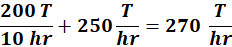
If a shift begins with paving material stored in a silo, that material effectively adds production capacity for the contractor. The amount of added capacity is determined by the amount stored and the shift length. For example, if a 10-hr shift begins with 250 tons of mixture in a silo, this equates to 25 tons/hr (250 tons/10 hr) of additional production capacity. Thus, the true production will be the tons/hour produced by the plant plus the added tons/hour supplied from the silo.
Determination of the required minimum number of trucks is an important aspect of planning for an asphalt paving project. The items stated above are needed to properly estimate this requirement. The minimum number of trucks needed can be calculated by the following equation:

Where:
T = tons
hr = hours
min = minutes
The answer is always rounded up. For example, if the equation yields 13.1 trucks, a minimum of 14 trucks will be needed.
EXAMPLE
Determine the minimum number of trucks for a job with the following information:
| Plant Production = | 250 T/hr (227 tonnes/hr) |
| Silo Charge at Start of Day = | 200 T (180 tonnes) |
| Shift Length = | 10 hr |
| Truck Capacity = | 20 T (18 tonnes) |
| Load Time and Ticketing = | 4 min |
| Tarping Time = | 2 min |
| Haul to Jobsite = | 35 min |
| Time on Site = | 4 min |
| Dump and Clean = | 4 min |
| Return Haul = | 35 min |
Step 1: Determine True Plant Production Rate
This will be the added production rate from the use of the materials stored in the silo at the beginning of a shift plus the plant production rate. In this example, 200 tons are stored that will be used over a 10-hour workday.
Step 2: Determine the Total Cycle Time
The total cycle time will be the sum of each of the steps encountered from the loading to the return of a single truck: 84 min in total.
Step 3: Calculate the Total Trucks Needed:

This number should always be rounded up. Therefore, 19 trucks will be needed to maintain a proper flow of mix to the jobsite.
The time interval between each delivery should be consistent, and the trucks should not be allowed to bunch up at the paver or at the plant. If a break in the delivery of material occurs, the paver contractor should stop the paver using a rapid stop technique and then use a rapid start when enough trucks are on the jobsite. This method will promote continuous paving. Starting and stopping the paver for each truck as it arrives on the project will reduce the smoothness and quality of the finished pavement and negatively affect the density of the mat.
Starting and stopping the paver for each truck as it arrives on the project will reduce the smoothness and quality of the finished pavement and negatively affect the density of the mat.
6.3 TRUCK TYPES
Three primary types of trucks are used for asphalt paving jobs: the end-dump, the bottom-dump or belly-dump, and the live-bottom or flow-boy.
Regardless of the truck or trailer type, the floor of the hauling unit should be smooth and free of dimples that might cause release agents to puddle. The side walls of the box should also be true to prevent material hanging up during discharge. Overall, the truck bed should be clean, well-maintained, in good condition, and capable of safely and legally transporting material to the jobsite. The lifting device on dump beds should be maintained so that the bed can be lifted to continuously move the material from the truck bed to the paver hopper. All hauling units should be continually monitored for signs of mechanical problems or leaking fluids (except air conditioning condensate) that can potentially damage the asphalt. If problems are found, the hauling unit should be immediately removed from the lineup until repairs can be made.
6.3.1 End-Dump Trucks
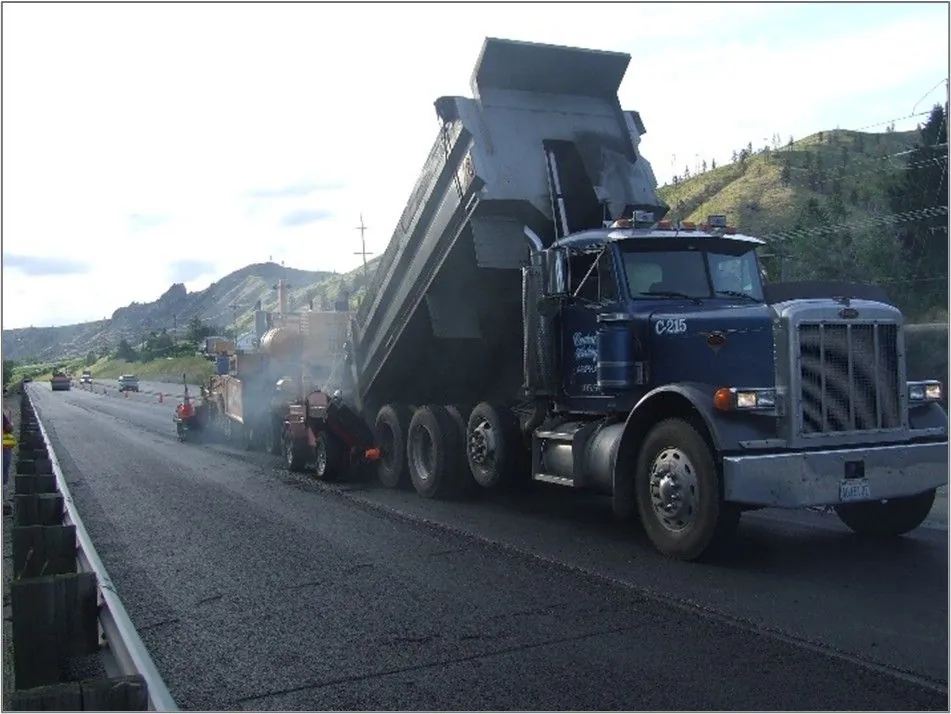
The end-dump truck delivers mix directly to the hopper of the paver or an MTV (see Figure 73). These trucks may have three to six axles and a capacity of 12 to 20 tons (11 to 18 tonnes). More axles mean more capacity. The advantage of the end-dump truck is its short wheelbase, which makes it easy to maneuver. The end-dump truck can also be a semitrailer truck, which is essentially a large, articulated dump truck, with a capacity of 20 to 25 tons (18 to 23 tonnes). The two disadvantages of this type of truck are that it requires improved operator skill and its large dump bed can cause problems with overhead obstructions (wires, bridges, and trees). Because of this truck’s size, special care should be exercised when loading it due to the increased potential for aggregate segregation. Especially for the larger end-dumps, care should be exercised to avoid having the truck bed pressing against the paver. This is most likely to happen when the bed is at its highest point
Source: Asphalt Institute
Figure 73. End-Dump Truck
6.3.2 Bottom-Dump Trucks
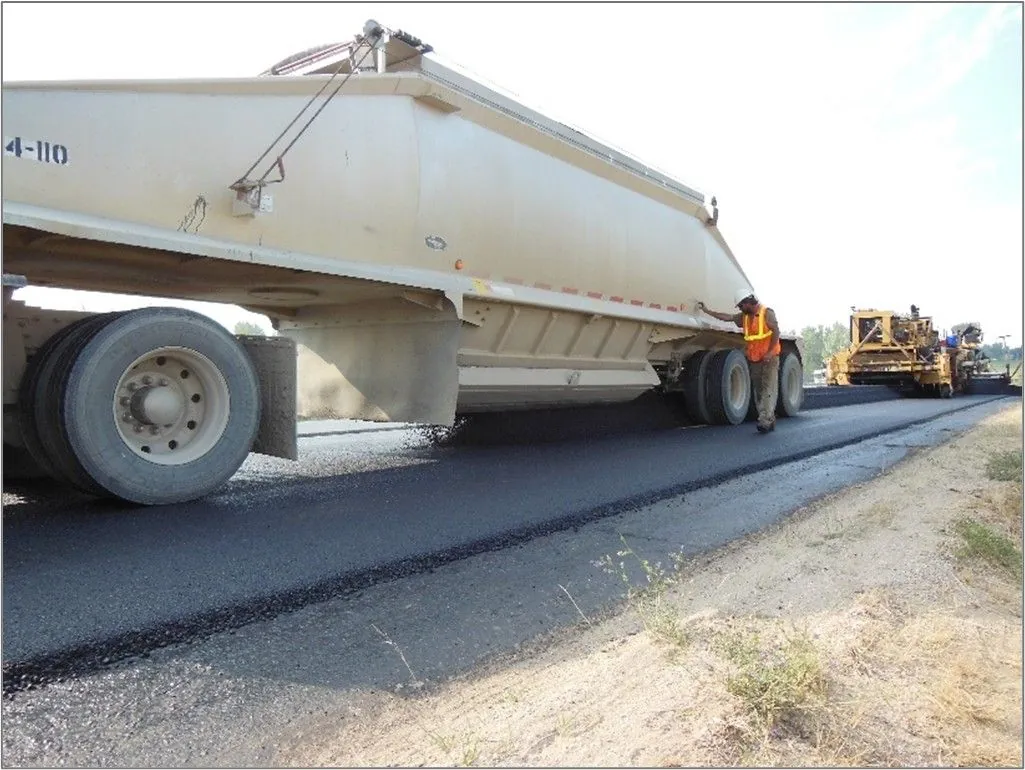
Bottom-dump trailers (often referred to as belly-dump trucks) are used when windrow paving is utilized (see Figure 74). Windrow paving is a process where asphalt mixture is placed directly on the roadway in front of the paver, which is equipped with a pickup machine (also known as a windrow elevator) that collects the windrowed material and feeds it into the paver hopper. This windrow elevator may be a standalone unit or may be connected directly to the paver.
Bottom or belly-dump trucks generally require that a dump operator be stationed on the grade to open the gates and control the spread rate of the asphalt material onto the grade in front of the paver. The dump operator is responsible for maintaining the proper amount of material to keep the paver hopper uniformly charged. The windrow should be consistently sized from truck to truck. During paving, if the quantity on the grade is found to not match the paving width or depth, material should be added or removed—without stopping the paver. The dump operator needs to be trained to also monitor the depth of material in the hopper to ensure that a proper volume of material is being supplied. They should adjust the discharge volume if necessary to properly balance the needs of the paving project.
Source: Asphalt Institute
Figure 74. Bottom-Dump Truck
6.3.3 Live-Bottom Trucks
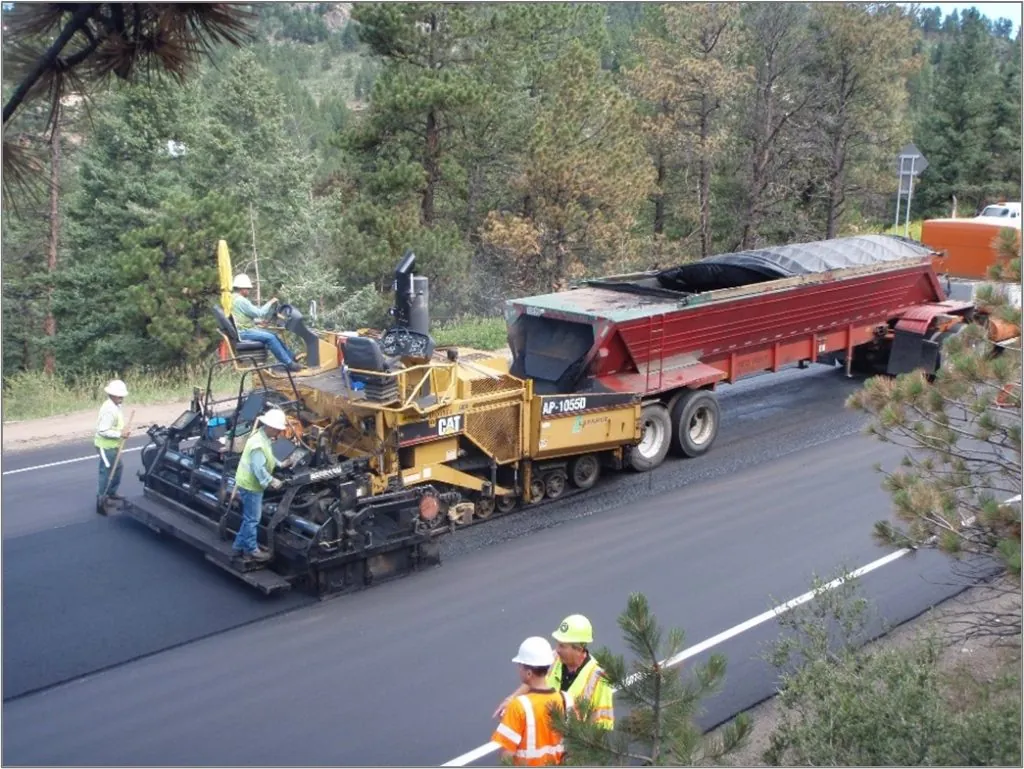
Live-bottom trucks (also known as flow-boy or horizontal-discharge trucks) have a conveyor system that moves the material from the hauling unit directly into the paver hopper without the need to raise the truck bed (see Figure 75). This system has a safety advantage because the bed does not need to be raised, so it is not prone to interacting with overhead hazards such as utility lines. Segregation is minimized as the material is moved in mass on the conveyor system or live-bottom system as it is discharged into the paver hopper. Moreover, this style of truck does not press on the paver hopper as can happen with end-dumps.
Proper cleaning of the conveyor or discharge plates ensures that cold chunks are not left in the truck bed. Daily checks between loads ensure that the system is operational and that no loose or damaged components will break during the workday.
Source: Asphalt Institute
Figure 75. Live-Bottom Truck
6.4 Proper Truck Loading
Watch Video
Segregation (both physical and thermal) is very difficult to deal with at the paver, as pavers are not designed to remix materials. Consequently, the procedures used to transfer the asphalt mixture into the haul vehicle are critical in minimizing segregation.
The use of best practices during loading can dramatically reduce the chance of segregation. Reducing the free fall distance, when possible, will help prevent segregation. Discharging the mix should always be in mass and dropped straight vertically into the truck. Trucks are loaded from a discharge gate at the bottom of storage silos on a drum or batch plant or, on some batch plants, directly from the discharge gate.
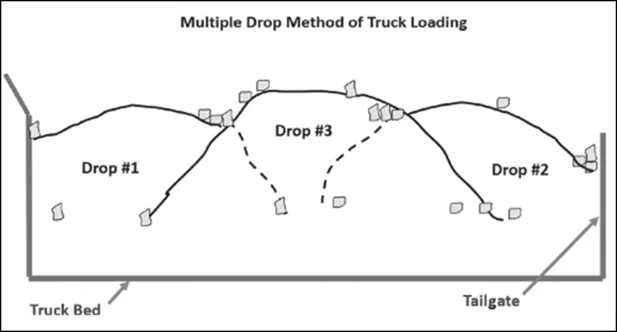
The number of tons loaded and the number of drops will vary depending on the size and capacity of the truck. It is a best practice to avoid loading with a single drop, which will cause segregation of the material and result in the larger aggregate rolling to the front and back of the truck bed. As illustrated in Figure 76, a minimum of three drops is recommended. It is a good practice to load the truck with multiple drops of approximately the same amount of material. The truck is moved forward and backward so that the loads are placed in a specified sequence with the first drop at the front of the truck bed, the second drop at the tailgate, and subsequent drops in the middle of the bed.
Source: Asphalt Institute
Figure 76. Example Truck Loading
For standard end-dump trucks, three drops are usually sufficient. Longer truck boxes will require more drops to prevent segregation (typically an odd number of drops). To facilitate loading, stations can be marked at the side of the loading area so the plant operator can direct the truck where to stop. Loading the truck using multiple drops to reduce the length of the face of the pile, and thus reduce the rolling distance for aggregate, will minimize physical segregation.
6.5 Hauling Procedures
After the haul vehicles are loaded at the plant, they must proceed directly to the paving location. It is important that truck drivers be thoroughly trained so they are aware of what is expected during loading, hauling, and unloading to maintain a steady flow of asphalt mixture to the paver. Haul trucks should not arrive simultaneously with other haul trucks (clustering or platooning). A notable exception is military airfield paving work, where platooned-deliveries may be required for ingress and egress from the facility being paved for security reasons. Driver training should focus on safe and timely deliveries as key elements in the construction of a quality asphalt pavement.
All haul truck beds should be smooth and clean. Truck beds should be inspected for cleanliness prior to loading them with fresh mix. The bed of the haul truck should be free of all deleterious materials before the mix is placed in it. Any debris in the bed from previous use of the truck should be removed. The bed should also be reasonably smooth and free of any major indentations or depressions where the truck bed release agent and mix could accumulate. The dumping lip should be cleaned between loads, and tailgate-latching devices should be lubricated so they release on command.
6.5.1 Release Agents
Once the haul truck bed is clean, it should be coated with a release agent to prevent the asphalt mixture from sticking to the bed. Nonpetroleum-based materials should be used for this purpose. While diesel fuel was once the most used release agent, it is no longer allowed and should not be used as it damages the mixture. Modern release agents are proprietary chemical packages that are supplied in concentrated form and diluted with water to application strength. Most agencies will have an “approved products list” for release agents. Manufacturers’ dilution and application rates must be observed to ensure good performance.
The release agent should be sprayed uniformly over the sides and bottom of the truck bed, using the minimum quantity necessary to cover the surface area of the bed without runoff. Any excess agent should be drained from the bed before the truck is loaded with mix. It is important to monitor the effectiveness of the release agent with the type of binder and mix being used. If trucks require excessive cleaning after each delivery, a different release agent may be appropriate.
6.5.2 Tarps and Insulated Beds
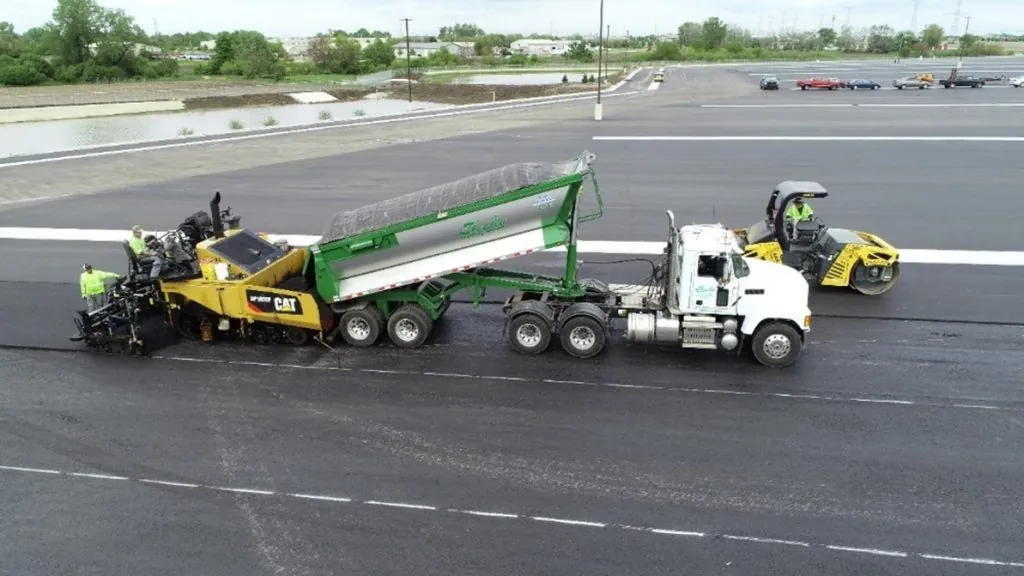
Maintaining the temperature of the plant mix during its journey from the plant to the paving site is imperative. If mixture temperature differentials of 25 °F (14 °C) or more occur, the mixture is considered thermally segregated. Cooler days and/or longer hauls increase the probability of this occurring. Ideally, all trucks should have insulated beds and an insulating waterproof cover (also known as a tarp) that overlaps both the sides and back of the bed to keep airflow and rainwater off the asphalt mixture (see Figure 77). The overlap should be at least 1 ft (0.3 m). The insulation should be both on the sides and the bottoms of the beds. These features assist in combating thermal segregation. Some agencies require the use of tarps regardless of weather conditions.
Source: Tim Murphy
Figure 77. Tarped Truck Bed
6.5.3 Truck Spacing
The goal of trucking is to provide a steady, regularly spaced, uninterrupted supply of consistent, homogeneous material. A factor in accomplishing this is to determine the ideal spacing between trucks. This ideal spacing can be determined based on the inputs for calculating the minimum truck numbers (see Section 6.2). Namely, the total cycle time divided by the actual number of haul trucks used should indicate appropriate truck spacing. Admittedly, a lot of external factors that are beyond the control of the contractor can come into play once a truck is on the road and alter this gap in real time.
The goal of trucking is to provide a steady, regularly spaced, uninterrupted supply of consistent, homogeneous material.
Maintaining the calculated interval and avoiding clusters of trucks at the asphalt plant at the paver can be a significant challenge. This is especially true on urban paving projects. Training is the key. Namely, training the truck drivers, plant operator, dump person, and paver operator on why this uniformity is desired and what to do when it is violated. When trucks return to the plant in a group, the plant operator should be trained to maintain the proper loading interval to reestablish the correct truck spacing. Similarly, when a group of trucks arrives at the paving site, the dump person and the paver operator should maintain their pace to reestablish the proper interval as well. Consistency builds a better road and airfield pavement.
6.6 Unloading the Mix
When the loaded haul trucks arrive at the paving location, the next step is to unload the trucks by transferring the asphalt mixture to the paver. The use of best practices to transfer the load of asphalt mixture from the haul truck to the paver is necessary to ensure that paver operation is continuous and that the mix is not segregated during the unloading process.
The onsite individual designated as the dump person controls the unloading of the trucks and has a major influence on both the smoothness of the mat and the potential for segregation. The paver operator must concentrate on the laydown process and is not available to address communication problems directly to a driver without stopping the paver. For this reason, a trained dump person is recommended.
The unloading procedure will naturally vary depending on the type of truck being unloaded. Thus, the following sections address unloading directly into the paver’s hopper, windrow paving, and the use of an MTV.
6.6.1 Direct Feed into the Paver
If an end-dump truck is used, the bed of the truck should be raised a short distance to break the load to the rear and allow the mix in the bed to shift and slide back against the tailgate before it is opened. This practice will cause any segregated coarse aggregate material to be incorporated back into the mass of mix rather than being delivered first into the paver hopper. Once the tailgate is opened, this procedure will also allow the mix to be discharged from the truck in a mass and to flood the hopper of the paver, further reducing the possibility of segregation behind the paver screed. In addition, raising the bed before the truck backs into the paver reduces the time required to unload the truck and makes the truck exchange more efficient. The use of tailgate chains to control the tailgate opening to reduce mix flow is seriously discouraged. Reducing the mix flow to a slow-moving stream could result in a major source of segregation.
The same procedure should be employed, if possible, when a live-bottom truck is used to transport the mix. On some such trucks, it may be possible to start the belt or slat conveyor for a few seconds before the end gate on the truck is opened. Doing so will create a mass of material that can be delivered to the hopper, instead of allowing any coarse aggregate particles that have rolled to the end gate to exit into the hopper first.
For both end-dump and live-bottom trucks, it is imperative that the trucks do not back all the way to the paver, bumping against it. Bumping the paver will create an indentation or bump in the mat that rolling cannot remove. Rather, these trucks should back to within 12–18 inches (300–450 mm) of the paver, as directed by the dump person or paver operator. At this point, the truck stops, releases the brakes, and waits for the paver to make contact.
For both end-dump and live-bottom trucks, it is imperative that the trucks do not back all the way to the paver, bumping against it. Bumping the paver will create an indentation or bump in the mat that rolling cannot remove.
After the paver contacts the hauling unit, push rollers mounted on the front of the paver facilitate moving the truck forward without interfering with the rotation of the truck tires. If a wheel-locking device is being used, it locks the hauling unit to the paver to prevent separation and spillage on the grade and simplifies the operation on rolling terrain. Once the wheel-locking device is engaged, the driver should be instructed to raise the dump bed and release the tailgate as quickly as possible to surge the paver hopper.
When a wheel-locking device is not used, the experienced truck driver will anticipate the sudden rush of material into the paver hopper and briefly apply additional brake pressure to prevent the hauling unit from being forced out from the hopper and spilling material onto the pavement directly ahead of the paver. Without a wheel-locking device, it may be necessary for the driver to continually maintain a slight pressure on the brakes to keep the truck from rolling away from the paver as the load is emptying. This is especially true when paving steep grades. Additional training for truck drivers is encouraged to minimize issues.
6.6.2 Windrow Paving
Windrow paving places the mix in a longitudinal windrow on the grade directly in front of the paver to facilitate a nonstop paving operation. A pickup machine operated in front of the paver picks up the material and places it in the hopper. Windrow paving operations are usually confined to warm, dry climates, where the chance of a surprise rainstorm cooling the material in the exposed windrow is minimal.
The dump operator plays a vital role in maintaining a quality paving operation. Proper windrow management will maintain continuous paving speed while minimizing segregation and heat loss. The quantity of mix on the grade is controlled by a dump operator as the hauling unit is unloaded and the size of the windrow is adjusted according to the level of material in the hopper. A well-trained crew can successfully pave for hours, producing a high-quality mix pavement without stopping.
The windrow-building process can allow the mixture to segregate, with the larger aggregate accumulating along the bottom outside edges of the windrow. Therefore, steps must be taken to ensure that the windrow pickup device picks up the entire windrow cleanly and that any segregated material is directed back toward the center of the material flow as it is moved through the windrow pickup device and into the paver. Adding plates to force the material into a smaller stream and keeping the volume of material in the hopper at a high level helps reduce mix segregation.
A uniform unloading process calibrated to the plant production and paver speed will assist in maintaining proper truck spacing and continuous paving. Once a windrow is started, each successive truck should back over and straddle the full cross-section end of the previously placed material to eliminate load-to-load segregation and maintain uniform windrow size. No more than one load of mix should be allowed to be exposed at any time.
6.6.3 Material Transfer Vehicle
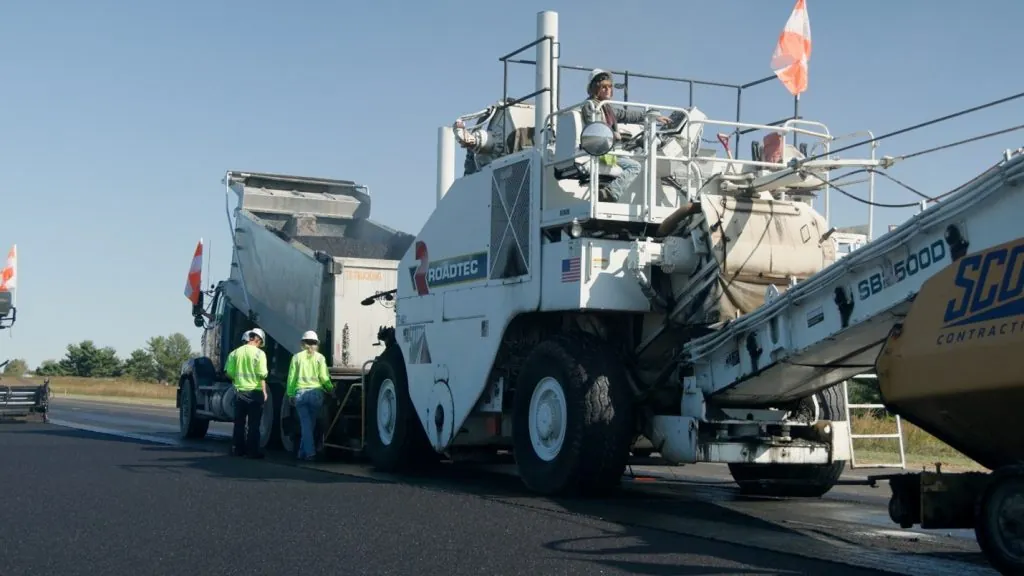
The MTV (see Figure 78) is primarily used to transfer the material from the haul truck to the paver hopper. The use of an MTV has several benefits but adds additional cost to the paving operation. An MTV has been shown to improve smoothness and reduce segregation. For these reasons they are specified to be used on airfields and are required on many highway projects.
When used properly, an MTV makes it easier to have a nonstop paving operation. The material holding bin or belt on an MTV acts as a surge hopper and can hold up to 25 tons (23 tonnes) of mix. A special insert in the paver hopper holds an additional 15 tons (14 tonnes). With the equivalent of two to three extra truckloads of material immediately in front of the paver, this onsite material storage is valuable because it allows for continuous paving even when there is a delay in truck deliveries from the plant.
Source: National Asphalt Pavement Association
Figure 78. Material Transfer Vehicle
When an MTV runs out of material, the paver must stop, and a continuous paving operation is not possible. Keeping a constant stream of trucks in front of the MTV is therefore necessary if a continuous paving operation is to be achieved. If a gap occurs, the MTV should be stopped without being completely emptied when waiting for trucks so that a consistent minimum amount of mix is retained on the augers to mix with the new material delivered from the next haul truck. In addition, the paver should be stopped with its hopper half full so that the amount of mix in front of the paver screed remains constant and the proper smoothness of the mat is achieved.
Loading materials into an MTV is like loading into a paver. Direct feed with an end-dump or live-bottom truck or a windrow operation can be employed.
Offsetting an MTV from the lane being paved can have noted advantages too. Namely, this practice can keep all the construction vehicles out of the paving lane. This protects the tack coat from contamination or tracking, improving its performance. Operating an MTV in this manner is generally required on airfield paving projects.
The mass of an MTV is quite large. Therefore, an assessment of the existing material’s ability to handle this loading without being damaged is important. Especially on low-volume roadways, caution is advised.
6.7 Tracking Quantities

Watch Video
During truck loading, the quantity (normally expressed in tons) is typically measured and stored electronically as part of the permanent project record. Each load is issued an individual and sequentially numbered load ticket that typically includes the type, quantity, and temperature of the delivered mix, the time of loadout, the accumulated total, and the identity of the truck. Also, any required Safety Data Sheet information can be preprinted on the back of the delivery ticket.
The quantity of mixture delivered from plant to paving site can be determined by one of the following three methods:
- Use a batch plant’s calibrated and certified plant scales. Use the accumulated weight of individual batches dropped directly into a truck from the pugmill or from a surge bin.
- Weigh loaded trucks on scales that can measure the tare weight of the truck and net weight of the mix. The scale must be level, horizontal, and of sufficient length to weigh all the truck’s axles at once.
- Use calibrated and certified load cells attached to the support legs of a portable surge bin to accumulate the subtraction of weight as the truck is loaded.
Paperless tracking of quantities is gaining favor with DOTs and contractors. This practice is known as e-ticketing. FHWA defines e-ticketing as “a paperless process for tracking, documenting, and archiving materials information, accessible in real time via mobile devices.” Moreover, FHWA has promoted the use of e-ticketing via the inclusion of e-construction technologies in rounds 3, 4, and 6 of its Every Day Counts program. The NCHRP published a synthesis of the current state of the practice in 2020 with Synthesis 545, Electronic Ticketing of Materials for Construction Management. The COVID-19 outbreak has been credited with the expansion in the use of e-ticketing. The elimination of paper that is handled by multiple people was seen as a means to deter the spreading of the disease.
E-ticketing streamlines the management of information by automating the collection, handling, and verification of mix production data. This allows for the real-time capture of construction data, which can then be mined as needed either during or after a project is completed. The data is recorded and archived automatically, streamlining the process. The information captured on an e-ticket is the same as on the traditional paper tickets.