

2.1 INTRODUCTION
The most essential part of project planning and organization is communication. While each agency may have its own detailed policy and procedures on how projects are organized, there are common aspects that can be highlighted. This chapter discusses five key aspects of project organization and how effective communication is a vital element of each.
- Project documents are written instructions, produced before the project is advertised, that should describe the requirements clearly and in detail.
- Preconstruction conferences initiate verbal communication between agency representatives and contractor personnel. This conference sets the tone for both the working relationship and direct communications during project execution.
- Ongoing communication between the contractor and the agency is essential to ensuring high-quality work.
- Ongoing records provide a means of tracking and communicating events, progress, test results, and overall performance. These records are typically produced daily.
- Safety on the job requires good communication among all parties.
2.2 PROJECT DOCUMENTS
Project documents are developed by the design team and are part of the bid letting. These documents illustrate and describe the scope of work to be done under the contract. Specific definitions of these documents and other terms that apply directly to a project are normally included in the first section of the governing standard specifications. Project documents include the following:
- Plans—Drawings that show the project location and layout, cross sections of the pavement, dimensions of the work, roadway or airfield appurtenances, striping and traffic control, and other details of the work to be done.
- Standard specifications—Written technical documents that provide detailed technical requirements for the materials, products, and methods used to perform the work described in the plans. These specifications are designed to ensure that the pavement performs adequately for its intended use. Some may outline performance criteria for achieving the desired outcome. Standard specifications are usually published by an agency as a volume of many specifications that the agency owns and periodically updates. Categories of standard specifications include materials, construction, QA, and performance.
- Special or supplemental specifications—Approved additions and revisions to the standard specifications. These are typically newer specifications adopted since the last standard specification volume was published.
- Special provisions—Additions or revisions to the standard or supplemental specifications that are applicable only to an individual project.
Agencies often incorporate several other documents by reference into the standard specifications, supplemental specifications, and special provisions. Material specifications and test procedures from AASHTO and ASTM are often listed in the specifications and become part of the contract documents. Additional documents, such as the Federal Highway Administration’s Manual on Uniform Traffic Control Devices (MUTCD) and Occupational Safety and Health Administration (OSHA) regulations, are treated in the same manner when referenced in the specifications. For airfields, AC 70/7460-1K Obstruction Marking and Lighting is an important document for construction equipment, etc.
Many of the material specifications and test methods written by AASHTO or ASTM for national use are modified by State or local agencies for their specific use. Governmental agencies often publish their own material specifications and test methods. These publications are also referenced in and become a part of the contract documents. Inspection manuals or guidelines are normally intended for use by the agency’s representatives and are not part of the contract documents.
If a discrepancy exists between the instructions and specifications in any of the contract documents, the order of priority, from highest to lowest, is usually as follows:
- Special provisions.
- Plans.
- Special or supplemental specifications.
- Standard specifications.
This hierarchy corresponds to the documents’ specific applicability to a project or contract.
Plans and specifications need to be accurate and complete, and they should leave little room for assumptions or interpretation. Accurate and complete contract documents result in comprehensive bids, save many hours of later discussion between agency and contractor representatives, and often prevent contract disputes that are expensive and time-consuming for all parties. To ensure that the full scope of the project is fully cataloged, pre-bid meetings and a time allowance for written pre-bid questions and official responses should be built into the bid-letting process.
If QA specifications are used, the requirements for the contractor to monitor its own work and for the agency or designated entity to do the necessary acceptance testing should be provided in detail. The project documents should clearly state testing methods and frequencies.
Chapter 11 is dedicated to the topic of QA, with sections on definitions, general types of specifications, QC plans, sampling methods, and QC at the plant and in the field, as well as acceptance.
2.3 PRECONSTRUCTION CONFERENCE
A preconstruction conference (or pre-paving meeting) should be held before work on a project begins, in time to allow for discussion, clarification, and any agreed-upon changes to be made. This conference is an opportunity to help all parties understand the responsibilities of the owner’s representatives and the contractor’s personnel. Details of the project should be covered so all affected parties understand the “who, what, why, when, where, and how.”
A preconstruction conference (or pre-paving meeting) should be held before work on a project begins, in time to allow for discussion, clarification, and any agreed-upon changes to be made. This conference is an opportunity to help all parties understand the responsibilities of the owner’s representatives and the contractor’s personnel.
Building a successful paving project is a partnership between all the parties involved, with the goal of delivering a top-quality result as a product of teamwork. Good communication is key, and the preconstruction conference sets the tone for future communication and cooperation. It is important that all aspects of the work be thoroughly discussed, potential problem areas be addressed, and any questions or concerns dealt with. All answers may not be available during the meeting, but action items can be assigned to provide the answers later when available. A good practice is to include a projected date by when each question should be answered to keep the questions from being forgotten.
Attendees at this meeting include key personnel representing the owner, contractor, subcontractors, testing firms, consultants, etc. Titles of key personnel include engineer, project manager, inspector, testing technician, superintendent, paving foreman, and plant manager. For airfield projects, airport management and airport operations should be represented to discuss airfield access, security, safety, etc. Lists of key personnel assigned to the project should be shared between the owner and contractor, with clear lines of authority and lines of communication delineated.
The agency is responsible for convening and conducting this preconstruction meeting. Agency personnel will outline the scope of the project, reviewing information provided in the contract documents. The agency representatives should also discuss any unusual aspects of the job—items that are not routine construction practices. The agency should review testing and sampling requirements to ensure everyone involved in the project understands the following:
- Purpose of all testing.
- Frequency of tests and taking of material samples.
- Responsibility for performing the tests and/or taking the samples.
- Location of tests or material samples.
- Details on handling, transporting, and testing of material samples.
- Timeframe and procedures for reporting test results and to whom they should be reported.
- Response to failing tests, including penalties, work stoppage, etc.
The individuals representing the contractor should be familiar with all aspects of the job and be able to speak with authority about their plans to accomplish the work. A progress schedule for the job should be presented and discussed with the agency representatives. Questions about the content in the contract documents should be raised and clarification requested. Because continuity of asphalt paving operations is critical to providing quality pavement, the contractor personnel should include items such as material sources, plant production rates, haul distances and routes, paving sequence, paving widths and speed, type and quantity of equipment to be used, etc.
The contractor QC plan is the process that the contractor will use to ensure that quality is controlled, and it should be discussed during the preconstruction conference as well. In particular, the testing that falls under QC should be covered, including how QC data is collected, reported, and perhaps used as part of acceptance. Chapter 11 discusses QC as part of QA.
Typically, on large projects and for all airfield projects, specifications require the construction of a test section prior to full asphalt mix production and paving operations. The purpose of the test section (also referred to as the control strip, test strip, etc.) is to evaluate the compliance of the job mix formula (JMF), mix production, transportation, laydown, and compaction relative to the requirements in the project documents. When the project specifies this approach, full production should not begin until an acceptable test section has been constructed and accepted by the owner.
One of the most important items to be addressed at the preconstruction conference is job safety, a topic also covered at the end of this chapter. Safety is the responsibility of everyone involved with the project. Discussion of this topic should include not only the safety of those working on the job (contractor, subcontractors, and agency personnel) but also the safety of the traveling public and any traffic likely to operate in the vicinity of the work zone (e.g., airplanes). Clear responsibility should be delineated for maintenance of all traffic control devices, such as signs, pavement markings, and flagging. The name of the contractor representative responsible for safety should be provided to the agency so that rapid and clear communications can be accomplished should safety issues occur. For airfields in particular, an emergency response plan should be discussed since access to the site is usually tightly controlled compared to roadways.
2.4 Ongoing Communication

Watch Video
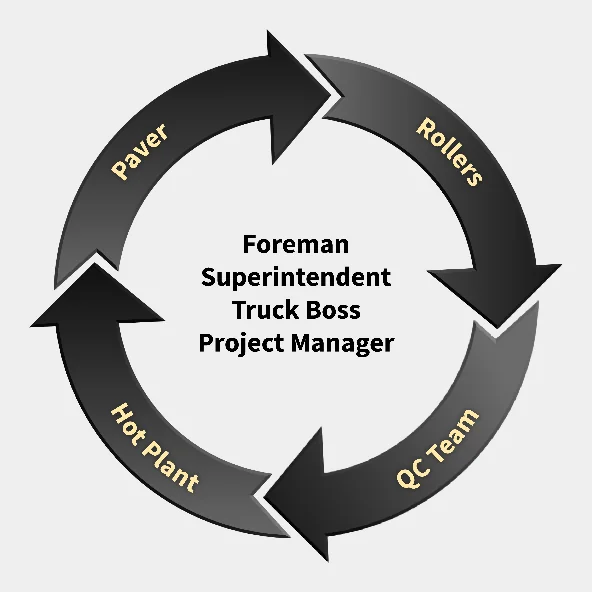
Communication cannot stop once the preconstruction conference has finished. The quality of the paving work, along with the safety of those performing and inspecting the work, is directly related to the quality of the ongoing communication between all parties involved. It is important that the individuals in daily charge of the project for both the agency and the contractor meet periodically, on both a formal and an informal basis, to discuss the progress and quality of the work done to date and the schedule for future work. Clear lines of communication should be established, as illustrated in Figure 2, with regards to QC.
Source: National Asphalt Pavement Association
Figure 2. Lines of Communication for Quality Control
2.4.1 Formal Meetings
The frequency of formal update meetings depends on the scope and the size of the paving job. On a major project, these should be held at a regularly scheduled time at least once weekly, such as every Monday morning at the project office. Key personnel from both the agency and the contractor should be present, and an updated “look ahead” schedule should be presented and discussed so that all parties can properly plan and coordinate. The meeting should be conducted jointly by the agency and the contractor and serve as a forum for constructive input to the job. Written meeting minutes should be taken and distributed to interested parties.
The discussion should include such items as the quantity of work completed and test results obtained. The meeting should also focus on what has yet to be accomplished and the schedule for the coming weeks. Any changes in personnel, equipment, construction methods, and JMF should be discussed. Problems that have arisen and those that are anticipated should be communicated to both parties, with solutions explored. Safety should also be reviewed.
2.4.2 Informal Meetings
Informal meetings should be held daily between the individuals in charge of the job for the agency and the contractor. Ideally, these meetings should occur at a regularly scheduled time and can be held at the asphalt plant or at the paving site. The purpose of these informal meetings is twofold. First, occurrences the day before such as work completed, test results, and any problem areas encountered should be discussed and resolved, including overall safety issues. Second, the discussion should address what is expected to happen that day and over the next few days. Various aspects of the overall safety plan and specific project hazards should be included in these daily meetings. Providing key takeaways from any recent formal meetings is also important.
Asphalt paving projects, like many construction projects, are not always conducted as originally scheduled. Changes occur because of problems with material supply, equipment breakdown, contractor and subcontractor schedules, and weather conditions. When such changes occur, it is important that they be communicated between the contractor and the agency. Daily informal meetings provide a forum for the exchange of such information. The team also needs to appreciate that paving projects are uniquely dynamic: work zones are mobile and bustling with dozens of pieces of moving equipment, including trucks entering and exiting, and are often spread out over thousands of feet.
Section 2.6 includes additional discussion on daily safety briefings.
2.4.3 Communication Formats
Communications can be oral, electronic, and written. Much information can be communicated in oral form, but discussion of important information, including a change of conditions or contract modifications, should be in writing. Issues should be resolved quickly so they do not hamper the project schedule and risk project costs, efficiency, or safety.
Personnel for both the agency and the contractor should keep daily diaries and photographs of events that occur. Occurrences noted in a daily diary may need to be remembered later, and a written log can help keep the details accurate and complete. Section 2.5 contains a more thorough discussion of daily diaries.
Electronic project management tools are available to help with project communication and necessary project documentation.
2.5 Ongoing Records
Watch Video
Accurate and complete records are needed for all construction projects. This is true both for the project engineer and staff and for the contractor’s general superintendent, plant and paving superintendents, and all foremen. Trying to accurately reconstruct events later without proper notes, photographs, and complete test data is nearly impossible. Moreover, taking pictures and videos with time and date stamps, and possibly geolocations, to document a paving project can prove invaluable when the project is reviewed. Conflicting opinions about what happened are common with poor recordkeeping practices. One rule of thumb should always be followed: If in doubt about whether the information is important or beneficial, record it.
Taking pictures and videos with time and date stamps, and possibly geolocations, to document a paving project can prove invaluable when the project is reviewed.
Workmanship is very important, as many problems are related to workmanship issues and are identified visually before they are determined by testing. Workmanship was covered in Section 1.4.
2.5.1 Plant Reports
The results of all daily and periodic tests conducted at the asphalt plant should be recorded. A variety of different forms may be used for this purpose. Contractor personnel should complete and keep their own records, even if not required to do so by the agency.
Data that should be recorded include project number and location information, project material sources, JMF information, aggregate gradation and asphalt content test data, mix temperature, mix test results, material quantities (of aggregate, asphalt binder, and additives) used, number of tons of asphalt mix produced, daily weather conditions, and the pavement location where daily production was placed (see Figure 3). Agency specifications may require additional information, such as the moisture content of the individual aggregate stockpiles. Any such required data should be reported on the appropriate forms.
It is important to record the date, time, and location of all samples taken, as well as the name of the individual who took them, on the form. Any additional information that pertains to the sample should be noted. For example, if aggregate gradations are determined from samples taken at two different locations (e.g., from the cold-feed belt and from the extracted mix), those locations must be marked on the report. Failing test results should be highlighted on the form as well as the action to be taken.
Most forms should have a “Remarks” area. This portion of the form should be used to indicate any unusual occurrences or test results that took place during the day. Any corrective actions or changes to the materials, plant operating conditions, or test procedures should be indicated, as should the results of those actions or changes.
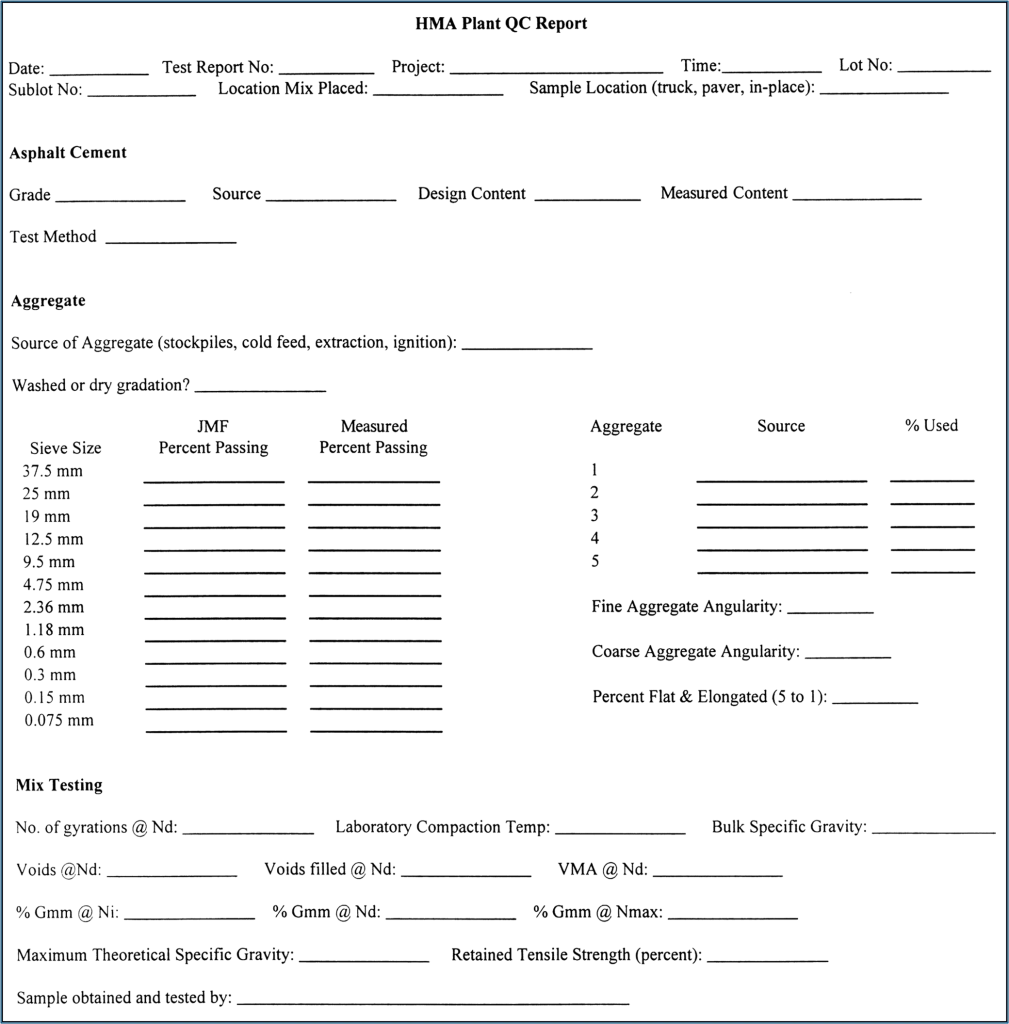
Figure 3. Plant Report Example
2.5.2 Field Test Results
Field tests are conducted concurrent with the paving operations. See Chapter 11 on QA for details on this phase of testing. On projects that utilize a QA specification, both the contractor and the owner’s representatives will be conducting testing and tracking the results. The key is to track all test results to evaluate how the contractor is performing against QA requirements. This allows the contractor to fine-tune their processes as needed to maximize the quality of the product and the owner to have confidence in what they are buying.
Information on what occurred at the paving site during mix placement and compaction operations should be recorded by both parties. The form of this information may differ between the agency’s paving inspector and the contractor’s superintendent, but essentially the same information should be reported by both. This consistency will allow for more meaningful discussions later if deficiencies should develop in the test results or in the performance of the mix under traffic.
Field compaction is widely held as the single most important construction property for the long-term performance of an asphalt pavement. A well-compacted dense-graded mixture will be impermeable to both water and air, resisting the aging effects of the environment. The mix is given the best opportunity to sustain the repeated loading from traffic when properly densified. See Chapter 8 for more information on compaction.
Field compaction is widely held as the single most important construction property for the long-term performance of an asphalt pavement. A well-compacted dense-graded mixture will be impermeable to both water and air, resisting the aging effects of the environment.
Data regarding field compaction should include the following: project number and location; type and number of tonnes (tons) of each mix placed and its exact location—layer number, thickness, lane, and station number; the location (both transversely and longitudinally—station number) of any tests taken; and the density results and method by which they were obtained.
Other project information that should be recorded includes weather conditions; type and make of compaction equipment used by the contractor; roller settings of amplitude, frequency, tire pressures, and ballast weight; type, amount, and location of any tack coat material placed; a running total of the tonnes (tons) of each mix placed on the project; and smoothness results obtained.
All samples taken must also be clearly identified on the form to reflect the location from which the material was gathered, the time and date of the sampling, the reason the sample was taken, the quantity of material the sample represents, and the name of the person who took the sample. Pictures and/or videos of the testing and the materials gathered are valuable. If a nuclear or non-nuclear gauge was used to determine the relative density of the mix, any calibration procedures used to check the reliability of the gauge should be referenced. Any failing test results should be highlighted. The “Remarks” area on the pavement report form should be used to report any unusual conditions or test results that occurred during the day. An explanation for any failing test results should be provided, if possible, and the steps taken to correct the problem should be noted, along with their results.
While the pavement’s density is the most important factor in controlling its future performance, its smoothness and grade must also be achieved for the comfort and safety of the pavement users. Moreover, smooth pavements have been shown to last longer than rougher ones, and proper grading is needed to ensure drainage is achieved. Automated data-collecting vehicles are commonly used to determine the overall smoothness of a pavement, but the use of traditional 10-ft or longer straight edges still has its place. Namely, a long straight edge is needed to verify that transverse joints are smooth. Chapter 9 offers detail on the proper construction of joints, while Chapter 11 provides a discussion on smoothness.
2.5.3 Daily Diary
All project supervisors, both agency and contractor, should be required to keep a detailed daily diary for possible later reference. This document should be used to record all pertinent information about the conditions and production for each day’s activities. Any changes that are made in the mode of operation of the asphalt plant or the laydown and compaction equipment should be documented along with why the change was made. The diary should have each day’s weather conditions recorded, with updated weather information added periodically as needed throughout each day.
The daily diary should also document any non-routine events that occur on the job, including visitors to the project. It should also be used to record the reasons for any delays in paving (e.g., an equipment breakdown or poor weather conditions) and the duration of the delay.
The use of time-stamped and geolocated pictures and videos to further document a project is encouraged. Common items to consider documenting at the asphalt plant setup with pictures and video include aggregate stockpiles, paving site, traffic control, mixture delivery, paver operations, joint construction, and the compaction process. Handheld thermal cameras or smartphone attachments are inexpensive and can be invaluable tools for documentation.
For the information in a diary to be accurate and meaningful, it must be recorded as the events occur or shortly afterward. The diary should be one of the first activities of each workday, and it should be updated at least twice a day—once around midday and again at the end of the day. If job conditions and schedules preclude making the midday entry, the events of the day should always be recorded upon completion of each day’s activities.
The information contained in the diary must be as detailed and complete as possible. If a conversation concerning project activity is held with other project personnel, whether agency personnel or contractor employees, the date and location of the conversation should be recorded. The names and titles of any people involved in the discussion should be noted, as well as the topics addressed. If changed work scope and/or costs are realized due to project discussions, it is essential to officially document any agreements reached and to produce a timely written and signed change order, usually before changes are carried out.
The importance of the information contained in the daily diary cannot be overemphasized. “Too much” documentation is not possible. A typical daily diary would be a bound notebook with printed consecutive page numbers. If one party to a dispute can present information written in a timely fashion in a diary, whereas the other can only rely on memory to reconstruct the events, the diary owner will usually have an advantage in the settlement of the disagreement. The information in the diary may also be useful for conducting follow-up research and for determining the reasons for premature pavement performance issues.
It is becoming more and more common to document diaries electronically using photos, electronic notes, voice memos/notes, etc. This electronic documentation should be carefully and regularly stored on an accessible server in a format that can be read by all.
2.6 Safety
Watch Video
Working around an asphalt plant can be hazardous. Machinery operation, high temperatures, noise, and moving delivery trucks and haul trucks all add to the possibility of an accident occurring. Common types of accidents at a plant include workers being burned by hot asphalt mix, getting sprayed with hot asphalt binder, crushing a hand in a piece of machinery, or being struck by a moving vehicle.
Working around an asphalt paving site can also be hazardous. Common types of accidents for those working around the paver include being struck by passing traffic, the paving equipment, haul trucks backing into or pulling away from the paver, and the compaction equipment. Burns from the hot mixture and equipment are also among the most common injuries.
Safety is everyone’s business on an asphalt paving project. Everyone working for the contractor—from the superintendent to the front-end loader operator at the asphalt plant, to the truck driver and the roller operator—must be continuously aware of the need to apply safe work habits. Likewise, everyone working as a representative of the agency—from the project engineer to the inspector at the paving site to a testing technician behind the paving operation—must all practice safe work habits. OSHA regulations must be known, understood, and followed by each person involved in the project.
Effective training and communication are key to a safe work environment. Every individual involved in the project should know what is expected and how to perform the assigned tasks. Proper training in the operation of a piece of equipment is essential for equipment operators. Retraining is necessary at frequent intervals.
Safety talks are a good way to start the day for both contractor and agency personnel. Several different organizations publish short, concise safety presentations that can be completed in 2 or 3 minutes. People need to be reminded that they are operating in a potentially dangerous environment at both the plant and the paving operation, and daily talks are one way of meeting this need. Further, if an unsafe work practice is noticed, corrective action should be taken immediately, even if the paving operation must be shut down until the unsafe practice has changed.
Individuals most likely to be hurt on an asphalt paving project are those who are new to this type of work. Without adequate training before they start on a paving project, these people do not fully understand the difference between following safe work practices and taking foolish chances. At times their enthusiasm to excel at a new job and to please others can overshadow their awareness of proper safety practices.
Needless injuries are also suffered by those who have been around the plant and the paving operations for many years and therefore may become overly comfortable and complacent with equipment and safety procedures. Safety should be as much a part of these individuals’ day as it is for those new to the job.
Constant care and vigilance are needed to prevent accidents and injuries associated with asphalt operations. OSHA, NAPA, the Asphalt Institute, State departments of transportation (DOTs), and other organizations have publications and videos that address asphalt safety. These tools should be made available to relevant personnel and be part of regular safety training.