

11.1 Introduction
Highway and airfield construction specifications are a means to an end. Their objective is to provide the traveling public with an adequate and conomical pavement on which vehicles and aircraft can move easily and safely from point to point. A practical specification is designed to ensure adequate performance at minimum cost; a realistic specification takes account of variations in materials and construction that are inevitable and characteristic of the best construction possible today.
Most agencies currently use a combination of method specifications, statistically based specifications, and end-result specifications, all of which will be discussed in Section 11.3. This combination shares the risk between agency and contractor, directly specifying some materials, equipment, and methods, but allowing the contractor to choose some also. What “acceptable” looks like is defined, and random sampling and statistical analysis of test results evaluate whether the contractor’s work is acceptable.
Although other QA topics will be introduced, the primary focus of this chapter will be on several elements of QC. The following subsections will discuss definitions of the primary aspects of QA.
11.2 Definitions
11.2.1 Quality Assurance
The definition of QA has evolved over the years. Earlier definitions described QA primarily as the methods employed by the owner/agency to ensure that they receive a quality product, a definition now closer to the term “acceptance.” Two documents are now referenced for definitions in this area: AASHTO R 10, “Definition of Terms Related to Quality and Statistics as Used in Highway Construction,” and TRB Circular E-C173, “Glossary of Transportation Construction Quality Assurance Terms.” Airfield specifications such as FAA’s P-401 and the DoD UFGS 32 12 15.13 use most of the terms synonymously with the AASHTO and TRB documents, but not always.
AASHTO R 10 defines QA as, “(1) All those planned and systematic actions necessary to provide confidence that a product or facility will perform satisfactorily in service; or (2) making sure the quality of a product is what it should be.” QA addresses the overall process of obtaining the quality of a service, product, or facility in the most efficient, economical, and satisfactory manner possible. QA includes the elements of QC, independent assurance, acceptance, dispute resolution, etc. QA involves continued evaluation of the activities of planning, design, development of plans and specifications, advertising and awarding of contracts, construction and maintenance, and the interactions of these activities.
11.2.2 Quality Control
AASHTO R 10 defines QC as, “The system used by a contractor to monitor, assess, and adjust their production or placement processes to ensure that the final product will meet the specified level of quality. Quality control includes sampling, testing, inspection, and corrective action (where required) to maintain continuous control of a production or placement process.” QC is also known as “process control.”
Public and private airfields often rely on contractor QC as a major part of their QA program, providing few, if any, agency inspectors. This does not mean that inspection is not done, or that quality suffers. Airfield agencies like FAA and DoD generally rely on different mechanisms than DOTs to accomplish the same goal of quality.
Airfield agencies like FAA and DoD generally rely on different mechanisms than DOTs to accomplish the same goal of quality.
11.2.3 Acceptance
AASHTO R 10 defines acceptance as, “The process whereby all factors used by the agency (i.e., sampling, testing, and inspection) are evaluated to determine the degree of compliance with contract requirements and to determine the corresponding value for a given product.”
QC measurements (sampling, testing, and inspection) may or may not be used in the acceptance decision process. When contractor test results are used in the agency’s acceptance decision, the process often includes agency verification and/or dispute resolution mechanisms.
11.2.4 Dispute Resolution
Agency and contractor labs sometimes generate conflicting test results. It is important for specifying agencies to outline a process to resolve conflicts that may occur. AASHTO R 10 defines dispute resolution as, “The procedure used to resolve conflicts resulting from discrepancies between the agency’s and contractor’s results of sufficient magnitude to impact payment.”
As an initial step, agencies may simply review multi-laboratory precision statements in AASHTO and/or ASTM to see if test results are within the acceptable range of two test results. A dispute resolution procedure may also include the testing and comparison of independent samples. Agencies may apply some type of statistical test (t-test) to determine for a group of test results how far apart is too far apart. The independent t-test is used to compare the means of two independently obtained sets of data. The paired t-test compares test results of split samples. If disputes cannot be resolved between the agency and contractor, third-party arbitration may be the final step.
11.3 General Types Of Specifications
Agencies need some method of communicating their expectations to the contractor. Specifications are part of the contract, and they communicate the requirements under which a contractor must successfully deliver a project. They should be clearly written so all parties can properly evaluate the degree of conformance and what happens if the work does not conform to the specifications.
11.3.1 Method Specifications
Method specifications (or prescriptive specifications) were probably the most widely used type of specification in highway and airfield construction until the mid-1980s. With this type of specification, the agency directs the contractor to use specific methods, including materials, proportions, processes, and equipment. If the contractor follows the requirements, the agency accepts the completed work and bears the complete burden of responsibility for the quality and performance. Terminology such as “substantial compliance” and “reasonably close conformity” is associated with method specifications.
An advantage of method specifications is that they offer extreme agency control when the expertise for a particular product or process is largely on the agency side. They may also offer an advantage when a measure of quality is particularly difficult to define. Asphalt mix segregation is one such case. Segregation is an undesirable feature (covered in detail in Chapter 10), but the allowable degree of segregation is difficult to measure or to specify. Thus, method specifications can be used to specify what a contractor must do to prevent segregation.
However, method specifications also have several disadvantages. Contractors may not be allowed to use the most economical or innovative procedures to produce the product. The corresponding inspection to ensure conformity is labor-intensive. If the quality of the product is measured and found to be less than desirable, the contractor has no legal responsibility to improve it if the methods were followed. The agency assumes the bulk of the specification risk.
The major weakness of this type of specification is that there is no guarantee it will produce the desired quality of construction. Most importantly, by explicitly specifying the material and procedures, the owner or agency obligates itself to a large degree to accept the end product. Such a specification is also very difficult to enforce uniformly. The terms “reasonably close conformity” and “substantial compliance” cannot be precisely defined. In the absence of a clearly established quality level and a uniform means of measuring compliance, decisions can become arbitrary, and acceptance procedures become inconsistent in their application.
11.3.2 End-result Specifications
The construction of the American Association of State Highway Officials (AASHO) Road Test in 1958 provided the first step toward end-result specifications. This type of specification offered a way to better assess and quantify the quality of construction than imprecise verbiage like “reasonably close conformity.” True end-result specifications require the contractor to take the entire responsibility for producing and placing a product. The agency’s responsibility is to either accept or reject the final product or to apply a pay adjustment that is commensurate with the measured degree of compliance with the specifications.
End-result specifications have the advantage of allowing the contractor flexibility in exercising options for new materials, techniques, and procedures to improve the quality and/or economy of the end product.
End-result specifications typically do the following:
- Assign the contractor complete responsibility and latitude in determining the procedures and equipment used to produce the product.
- Leave QC sampling, testing, and inspection entirely at the discretion of the contractor or producer.
- Base agency acceptance on sampling and testing of the final in-place product.
- Determine a price adjustment based upon the measured degree of compliance with the specification criteria.
End-result specifications stress sampling and testing of the final product, as opposed to inspection, as the main measure of agency acceptance. A large quantity of material may be found to be defective after it is already in place, when there is very little opportunity for correction. This is risky because the specifying agency may accept a certain amount of undesirable product. Because only the final product is tested, this also discourages accumulating testing results throughout construction to obtain a more representative picture of the product quality.
11.3.3 Quality Assurance Specifications
QA specifications evolved from complications with method specifications and end-result specifications. This type of specification is the most used today. AASHTO R10 defines them as specifications that require contractor QC and agency acceptance activities throughout the production and placement of a product. Final acceptance of the product is usually based on a statistical sampling of the measured quality level for key quality characteristics.
QA specifications evolved from complications with method specifications and end-result specifications. This type of specification is the most used today.
The contractor’s QC and agency responsibilities should be clearly defined. On the contractor side, a QC plan should be documented that identifies all QC personnel and procedures that will be used to maintain production and placement processes in control and meet agency specification requirements. The plan must also address corrective action to be taken if the process goes out of control. More information about QC plans can be found in Section 11.4.
Other key areas to document in a QA specification include the following:
- How asphalt mix designs are submitted and how they are verified.
- How plant and field performance is verified (e.g., trial batches, control strips).
- How QC testing and inspection will be used to monitor work.
- Whether and how QC test results will be used for acceptance.
- Details regarding agency inspection and acceptance procedures.
As part of QA specifications, the material quality characteristics to be sampled, tested, and inspected for QC and acceptance must be identified and clearly outlined. For example, a specification might identify mix gradation, binder content, thickness, VMA, laboratory air voids, and in-place air voids as contract quality characteristics. Other characteristics that measure smoothness, runway grooving, rut resistance, crack resistance, etc., might be included, depending on the project size.
Other important information to include in a QA specification would be the location of sampling, sampling methods, lab handling methods, and test methods to be used on the samples. How often to sample and test should be clearly spelled out, as well as how and to whom test results will be reported. The selected quality characteristics should be related to product performance and should be clearly measurable.
The measure of quality (MOQ) to be used for acceptance must be specified. The MOQ is any of several mathematical tools that are used to quantify the level of quality of an individual quality characteristic. Common MOQs include the mean, standard deviation, average absolute deviation (AAD), and percent within limits (PWL). AAD and PWL are two of the most common MOQs.
11.3.3.1 Absolute Average Deviation
If a specification merely required the average result to be within a certain range, initial high values could purposely be later offset by low values to bring the mean into the target range. The same would be true for the average deviation, which would include whether the deviation from the target was positive or negative. While using the mean or average deviation might be valuable QC tools for monitoring trends, they are not appropriate for acceptance.
The AAD uses the absolute deviation of a test result from the target value, without regard to signs. An advantage of AAD is that it is very easy for any technician to understand the mathematics of averaging individual test values’ differences from the target value and be able to picture that AAD shows, on average, by how much a target was missed. A low AAD implies that the data is both close to the target and has low variability.
However, there are disadvantages to AAD. Using absolute deviations, AAD does not signify whether deviations are always low, always high, or some mix of the two. A high AAD does not necessarily mean that there is both poor precision and accuracy. The results could be very precise but not accurate. Therefore, AAD does not fully measure variability. And for one-sided specifications like VMA, there is no target from which to calculate AAD, only a minimum.
A similar MOQ, Conformal Index, measures the squared deviation from the target. While the Conformal Index may be a better measure of accuracy, it presents the same disadvantages as AAD.
11.3.3.2 Percent Within Limits

Watch Video
For pure statistical accuracy, the MOQ adopted by most agencies is PWL. It is more discerning than other quality measures. The PWL procedure is based on the normal distribution, which is a continuous probability distribution having a bell-shaped curve defined by the sample mean and the sample standard deviation. The area under the normal curve can be calculated to determine the percentage of the population that is within certain limits.
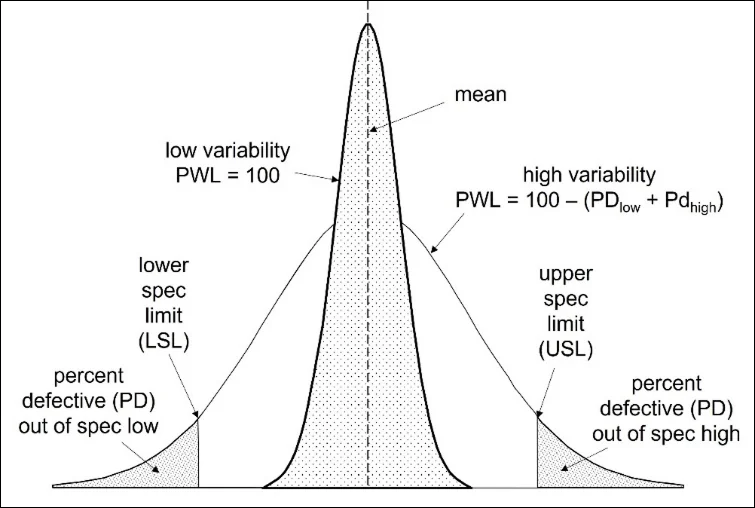
Figure 161 illustrates the concept. All the data is represented by the area under the curve. The figure shows two datasets with the same mean at the target value, one with low variability and one with a higher variability. The lower limit set by agency specification is shown as the lower specification limit (LSL), and the upper limit set by agency specification is shown as the upper specification limit (USL). The lightly shaded, low-variability data is completely within the specification limits (100 PWL) and would receive full pay and perhaps some type of bonus. This data would be both accurate and precise.
The wider high variability curve data averages the same as the low variability curve but is much more variable. It contains data both below the lower specification limit and above the upper specification limit. These areas can be calculated and are referred to as the percent defective (PD). The PWL of the wider variability data would be calculated as 100 – (lower PD + upper PD). This data would be accurate but not precise. Most agencies allow down to 90 PWL (10 PD) for 100 percent pay.
Source: Asphalt Institute
Figure 161. Percent Within Limits
Both datasets in Figure 161 are centered around the target value. If, for example, the dataset had low variability but was off target on the low side, the curve would shift to the left. If the average of the data was low enough, there would be some PD on the low side, but none on the high side due to the low variability of the data. In this example, the data would be precise but not accurate.
Although PWL is not as easy as AAD for technicians to understand and calculate, it offers some advantages. It is more statistically discerning than other MOQs. It efficiently captures the mean and standard deviation of the data into one MOQ. Like other QA specifications, PWL encourages uniformity. Uniformity is a proven predictor of performance.
11.3.4 Performance Specifications
Many agencies are working toward performance specifications. AASHTO R 10 defines performance specifications as those that describe how the finished product should perform over time. Although there are several types of performance specifications, warranties often come to mind when discussing them. In a warranty specification, the contractor assumes all the risk for how the pavement performs and takes on all maintenance activities required to maintain the performance at a specified level.
The following are shortcomings to using warranty specifications:
- They require long-term monitoring, with associated administrative needs.
- They require distinguishing between design- and construction-related problems.
- They typically are subject to reduced bonding capacity.
Because of risks associated with future uncertainties, bonding companies are typically not willing to provide warranties to contractors beyond 5 years. This increases the overall cost of the project to an agency.
Two other categories of specifications that fall under the umbrella of performance specifications are performance-related specifications and performance-based specifications.
Performance-related specifications describe the desired levels of key materials and construction quality characteristics that, in clearly defined conditions, have been found to correlate with fundamental engineering properties that predict performance. These characteristics, for example air voids, tend to lend themselves to acceptance testing at the time of construction.
Performance-based specifications describe the desired levels of fundamental engineering properties (e.g., resilient modulus, creep properties, and fatigue) that are predictors of performance and appear in primary prediction relationships. These models can be used to predict stress, distress, or performance from combinations of predictors that represent traffic, environment, supporting materials, and structural conditions. Most fundamental engineering properties generally do not lend themselves to timely acceptance testing.
NCHRP Synthesis 492, Performance Specifications for Asphalt Mixtures, is a good, comprehensive reference on this topic.
11.4 Quality Control Plan
Some form of QC (or process control) is provided during the production of all asphalt mixes. There are two key aspects of QC testing. The first is measuring specific characteristics and inspecting those activities that affect the quality of the finished product. The second aspect is providing the results of those measurements and inspections in a meaningful and timely way that allows adjustments during the production process. The subsequent adjustments or corrective action can thus minimize non-complying materials from being incorporated into the finished work.
There are two key aspects of QC testing. The first is measuring specific characteristics and inspecting those activities that affect the quality of the finished product. The second aspect is providing the results of those measurements and inspections in a meaningful and timely way that allows adjustments during the production process.
The amount of QC data and the level of control vary greatly from one project to another. Some project specifications require the contractor to exercise extensive control and mandate specific tests and test frequencies. Other specifications allow the contractor or the supplier to determine the level of testing based on their own judgment of what data is needed to adequately control the production process.
11.4.1 Selection of Sampling Methods and Sample Frequency
Watch Video
Methods and locations of sampling can have a significant influence on the outcome of the parameters being measured for QC. Sampling, therefore, is an important aspect of the overall QC program.
The methods and frequencies selected for sampling are not always the same for QC as they are for acceptance. The sampling methods used to determine the aggregate gradation are one example. Some contractors use cold-feed belt sampling methods for testing aggregate gradation for QC purposes. These samples are taken at the asphalt mixing plant and can provide test results within hours of sampling. These QC results allow any necessary adjustments to be made throughout the day.
Acceptance results should be communicated to the contractor in time to make any necessary adjustments, typically within 24 hours. But sometimes they may not be received until days after placement, potentially causing several days of mix to be placed out of specification. The amount of time needed to get results is an important factor in the selection of sampling methods during production.
11.4.2 Selection of Testing Methods
Watch Video
Traditionally, control of mix production was almost exclusively driven by binder content and aggregate gradation. As QC testing during mixture production improved, and as the technical understanding of the volumetric factors affecting longevity of asphalt pavements progressed, there has been an increased emphasis on controlling these properties in the mix. Most agencies now include mixture volumetric tests in their requirements for both QC and acceptance.
To predict long-term durability, some agencies are now including performance tests in their QA or acceptance criteria. The Balanced Mix Design philosophy (as discussed in Chapter 3) combines performance testing and traditional mix testing to enhance the mixture’s ability to perform over time.
Based on NCHRP Synthesis 346 “State Construction Quality Assurance Programs,” most State DOTs in the United States select specific sampling and testing methods that are to be used at minimum for QC on their projects. These testing requirements are typically identified in the standard specifications. Many agencies include QC line items in bids to reimburse contractors for costs associated with providing the tests. The synthesis report identified the following parameters that may be required for QC testing programs:
- Asphalt binder content.
- Aggregate gradation.
- Compaction.
- Volumetric properties (air voids, VMA, VFA).
- Ride quality.
- Aggregate characteristics (course aggregate angularity, fine aggregate angularity, flat and elongated particles, sand equivalent, etc.).
- Pavement thickness.
Many of the test values are compared with the JMF. When that is the case, the same tests should be used for QC as were used in the development of the JMF. It would not be advisable, for example, to use Marshall density values to evaluate air voids on mixes that were designed using Superpave.
For tests that are not compared with the JMF, the test methods selected for QC purposes may be different from the test methods used for acceptance of the same parameter. For example, QC testing often uses nuclear or non-nuclear density gauges to give an indication of roadway density during rolling operations. Agencies commonly require cores to be cut from the finished pavement for final acceptance of density. Test results from cores come too late to be used for adjusting the compaction operation in real time because the asphalt has already cooled. Density gauge readings can be taken while the mix is still hot and the compaction operation is ongoing. Thus, gauge test results can be an important part of the overall QC program for asphalt compaction.
Since QC methods must emphasize timeliness and convenience, the results can be less accurate and more variable. If the QC test method is different than the acceptance method, a minor shift in the data should be anticipated. It would be unreasonable, for example, to stop compaction operations when a reading of 92.6 percent compaction was read on a nuclear density gauge if the minimum required compaction was 93 percent using core densities. A higher target could be established to account for the likely variation and the possible shift of compaction values from the nuclear density method to the core density method. It is also a prudent QC measure to correlate QC test methods and laboratories to the acceptance methods performed by the acceptance laboratory. This can be accomplished by comparing gauge readings to core densities obtained at the same locations from a test strip or at the beginning of mix production.
If a gauge is being used to control density, an accurate correlation to core densities should be established. For each density gauge, it is reasonable to expect a consistent offset value from a gauge reading and that obtained from a core. Most agencies have established methods for correlating gauge values to those from cores.
11.4.3 Written Quality Control Plan
Watch Video
Most agencies that specify QC sampling and testing on their projects also require the contractor to submit a “Quality Control Plan” before beginning paving operations. The requirements for these plans can be extensive and usually involve more than just sampling and testing plans. They will generally require documentation verifying compliance with certain project requirements related to the QC program. NCHRP Synthesis 346 indicates the following items are usually required as part of written QC plans for plant mix production:
- Responsibility matrix showing who is responsible for reviewing QC results and directing any corrective action.
- Sampling and testing plan identifying specific tests and frequencies to be used for the project.
- Documentation demonstrating that the plant meets the required qualifications, certifications, and inspection frequencies.
- Documentation demonstrating that the laboratory that will provide the QC testing meets the required qualifications and accreditations.
- Documentation of the equipment contained within the laboratory and any calibration certifications that may be necessary.
- Documentation demonstrating that the technicians who will provide the sampling and testing meet the required qualifications and certifications.
- Example report forms, including control charts that summarize certain key data on plots that can rapidly show trends that need attention.
- Written procedures describing criteria that will be used to identify “out of control” production, what actions will be taken when materials fall outside of those criteria, and what the timing/deadlines of these actions will be.
An example sampling and testing plan that would be a part of the QC plan for mixture production is presented in Table 10, showing both the ASTM and the AASHTO methods. The methods are not interchangeable because they are not always the same. Therefore, standard specifications should designate the method to be followed.
Table 10. Example QC Sampling and Testing Plan

After the project is awarded, the written QC plan is generally submitted to the owner for review and approval. The plan is usually submitted with other project documents related to the mix production, like the asphalt mix designs for all the mixtures to be used on the project, aggregate source qualification testing, certifications for commercially provided materials that will be incorporated into the mix, designation of what plant or plants will be used for production, and the paving plans. After the review and approval process is completed, the contractor is generally authorized to begin production, unless the project specifications call for production of a trial batch and/or test strip.
11.5 Sampling Methods
The methods used for sampling asphalt mix can have a significant effect on the outcome of the test results. If a sample is not representative of the material, there is no point in following through with the testing program. Proper sampling techniques and specified procedures must be followed for an accurate representation of the materials being produced.
11.5.1 Representative Sampling
A primary goal is to obtain samples that are representative of the products being evaluated. Since test results are used to adjust mixture production, it would be counterproductive to make plant adjustments based on a non-representative sample.
Representative samples are critical for effective QC and acceptance programs. Inspection is more appropriate for identifying nonuniform portions of the work. Once inspection has identified a portion of the work that is nonuniform (different from the rest of the work) or defective materials are suspected, additional samples representing that specific element of the work should be taken. Test results from such samples should never be used as part of the lot averages—and certainly not for lot acceptance. They only represent the specific problem areas identified by inspection. Standard specifications should offer guidance on how to handle suspect areas.
It is important to collect enough material when sampling. The sample size is important not only to obtain enough material to complete the required tests but also to achieve a representative sample. Most standards will indicate a minimum sample size requirement.
The quantity of asphalt mix produced on a given project is usually divided into predefined portions called “lots.” QA and QC plans usually require samples to be taken at intervals within these lots. The intervals are generally measured in one of the following three ways:
- Time intervals—Typical lot sizes when sampling by time interval would include either a half day’s production or a full day’s production.
- Quantity intervals—Typical lot sizes when sampling by quantity interval would include 5,000 or 10,000 tons (tonnes), depending on anticipated production rates.
- Distance intervals—Typical lot sizes based on linear feet (meters) of paving. For example, cores are commonly taken based on a linear distance relative to stationing (a length of 100 ft [or 100 or 1,000 m] along a survey route) and an offset from a fixed longitudinal line.
Lot sizes are normally established by standard specifications, as defined well in advance of construction. The size and method of measurement of a lot will be used to determine locations and quantities of QC and acceptance tests. The lot will also be used to define what portion of the work is represented by a given set of test results. The limits of the lot are especially significant if corrective action or removal is required.
11.5.2 Random Sampling
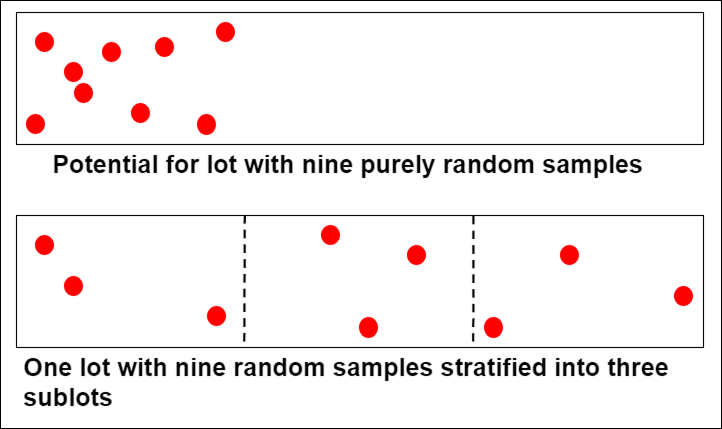
The use of random sampling techniques helps to obtain unbiased representative samples, where every element in the population has an equal chance of being selected for sampling. As shown in Figure 162, it is theoretically possible for the purely random numbers to require that all samples for the entire project be taken over a very small area. The best and most practical method of ensuring that samples include the full range of construction is a process called stratified random sampling. This practice separates lots into equally sized sublots, from which random samples are then obtained. ASTM D3665 provides the standard practice for random sampling of construction materials.
Source: Asphalt Institute
Figure 162. Purely Random Sampling vs. Stratified Random Sampling
Stratified random sampling can be applied to different types of intervals by taking the number of samples needed and distributing them over times, quantities, or locations.
Watch Video
Taking pavement cores is one of the most important ways to verify that asphalt construction meets specifications. Cores provide direct evidence of thickness, density, and overall quality—information that can’t be fully confirmed by surface measurements alone. This video walks through the complete process step by step: how to determine the right number of samples, how to select random locations to avoid bias, and how to properly operate diamond bit coring equipment. It also includes best practices for extracting, labeling, and handling cores to ensure accurate testing results. Together, these steps help agencies and contractors confirm performance, document compliance, and build confidence that the finished pavement will stand the test of time.
Table 11 illustrates how to calculate random sampling tonnage for loose asphalt samples from truck beds. The example is for a project with 4,000-ton (tonne) lots and 1,000-ton sublots. Random numbers can easily be generated by computer. In the example, the random number is applied to the sublot amount only, then the cumulative amount is calculated. For sublot 3, remember 2,000 tons have already been produced in sublots 1 and 2. Therefore, the random tonnage within sublot 3 (263.7) is added to the 2,000 tons, and the truck containing ton 2263.7 is sampled.
Table 11. Example Random Sampling by Tonnage Table

Source: Asphalt Institute
The above example presents sampling based on quantity increments. They are useful for planning random samples of loose mix during plant production. These same methods and spreadsheet solutions could be applied if samples were to be obtained based on location. For example, sampling increments for roadway coring would be planned at both a given station and a distance from the centerline. The random numbers could be generated by hour if lots were assessed by half-day or one-day intervals.
11.5.3 Sampling Asphalt Mixtures
Watch Video
Sampling requirements are typically set by the agency and should be identified in the contractor’s written QC plan. Acceptance sampling is often performed by the contractor but is required to be witnessed by agency personnel. Agency personnel typically take possession of the samples immediately after they are taken. It is important that all samples be properly documented with, at minimum, the project number, the date sampled, the material type, and sampling location (lot and/or sublot number). Other identifying information may also be required by the agency.
Sampling methods are available for sampling plant mix at many points along the construction process, including at the plant, from delivery trucks, from windrows at the jobsite, and from behind the paving machine. Some agencies may require one sampling point for QC and a different sampling point for acceptance.
For these sampling methods, the procedures described in AASHTO R 97 or ASTM D979 should be followed. Specifiers should carefully consider the sampling location. Each allowable sampling location in these standards has pros and cons related to the probability of obtaining a representative sample, the probability of causing permanent defects in the new mat, and the relative safety of the technician while sampling.
A common thread throughout the procedures is that they all require at least three randomly selected increments, combined to make a field sample meeting the minimum size requirement.
Samples of the compacted plant mix can also be taken by cutting cores from the cooled pavement following methods described in ASTM D5361 or AASHTO R 67. A brief discussion of each preferred sampling location is presented below.
11.5.3.1 Sampling at the Plant
Some asphalt mixing plants are equipped with sampling devices to obtain samples before delivering to the haul units. Such devices often include a sampling receptacle to pass perpendicularly through the entire stream of asphalt mixture, or they may include a sampling device that diverts the entire stream into a sampling receptacle. It is important that 1) the entire stream is sampled and 2) the sampling receptacle does not become overfilled during sampling and spill over the edges, losing part of the sample.
11.5.3.2 Sampling from Trucks
Truck sampling techniques are used to obtain samples of the plant mix. Quite often, the samples are taken immediately after loading from the plant, where sampling platforms allow the technicians to stand at the height of the truck bed. The truck bed is visually divided into three or four equal sections, and a sample is collected from each section. The top 6 to 12 inches (0.15 to 0.3 m) of material is removed before sampling from the exposed area.
11.5.3.3 Sampling from Windrows
Representative samples can also be taken from the windrow of a transport unit, avoiding the beginning or end of the windrow section. The windrow is visually divided into approximately three equal sections, and the top 1 ft (0.3 m) of the windrow is removed before sampling. The mix can become segregated in the windrow, so care should be taken in using the sample as QC for plant adjustments.
11.5.3.4 Sampling Loose In-place Mix
Representative portions of plant mix can be obtained by sampling behind the paving machine. These samples are taken immediately after placement but before any rolling takes place. The use of plates can help with obtaining a full sample, but any method must include the full depth of material. The holes from where the sample was obtained must be refilled before the roller reaches it. The mix can become segregated in the paver augers, so care should be taken in using the sample as QC for plant adjustments.
11.5.3.5 Sampling Compacted In-place Mix
Core sampling is the most common method for compacted asphalt pavements. Portable electric drills with wet-cut, diamond-studded core barrels provide rapid removal with little or no damage to the specimens. These samples are normally used to evaluate compaction and thickness.
Once removed from the pavement, the test specimens must be handled with care because they can be sensitive to damage from heat, impacts, and point loads. To protect the specimen, some QC plans require specially designed and padded transport containers. It is very important to ensure that the core holes are properly refilled and recompacted.
11.6 Quality Control At The Plant
Every successful asphalt contractor controls the quality of the asphalt mix throughout the production process. The plant itself must be calibrated/verified to be operating properly, as discussed in Chapter 4. All weighing mechanisms must be regularly certified for accuracy. Belts and gate openings must be properly adjusted for uniform material flow. Binder tanks must be maintained for proper circulation, temperature uniformity, and flow. Emissions must meet local environmental regulations and be adjusted for proper return of fines to the mix. All ancillary tanks and feeders must constantly be maintained and managed. The following sections provide more considerations about control of the mix and component materials.
11.6.1 Plant Control of Aggregate
Design qualities are the main consideration when selecting aggregates for a JMF. The decision concerning which aggregate to use is based on laboratory test data and mix economics, long before the material reaches the mix production plant (general characteristics and physical properties of aggregates for surface and base courses were discussed in Chapter 3). The raw aggregates should come from sources approved by the agency and should be stored (most often in stockpiles) and tested for compliance with designated quality standards.
11.6.2 Plant Control of Asphalt Binder
Asphalt binders are generally purchased from a source tested and accepted by the agency or accepted based on the supplier’s certification or agency testing. Cost and local preference will affect the selection of a supplier. In many areas, the purchase agreement with the asphalt supplier requires certification of the test results from a production run of material or an identifiable lot of material. Strict QC procedures may also require that the hauler supplying material to the plant furnish a “prior load certificate,” which protects the supplier of the load from disputes resulting from contamination during transport. These requirements should be specified when executing a purchase agreement.
Tests for asphalt are rarely performed by the plant QC personnel. It is good practice to randomly sample incoming loads of asphalt binder for future testing if necessary. The agency may also sample asphalt binder at the plant and run tests in the agency laboratory. In this case, samples stored on-site are useful should any question arise about the quality of the asphalt binder.
Asphalt suppliers generally have very robust, well-documented QC programs. Binder quality at the gate is the expected standard. However, even if the binder itself meets specifications, plant operators must ensure that they are receiving the proper grades and storing them in the proper tanks, with no contamination. If the incorrect binder was used, the mix properties and laydown characteristics will change. QC technicians and agency inspectors should regularly verify the purchase invoices and certificates of tests submitted by the asphalt supplier to help ensure the correct binder is being used on the project.
The temperature of the incoming asphalt binder must be closely monitored. Specifications set limits on the allowable temperature in the asphalt storage tanks. Overheating by the supplier or hauler is cause for rejection of the asphalt binder.
11.6.3 Plant Control of Asphalt Mixtures
Plant control of mixtures includes a series of elements so closely interrelated that they are difficult to separate. One test may perform a variety of functions, satisfying a number of these QC needs. The day-to-day plant control that requires QC testing is as follows:
- Stockpile or cold-feed gradations.
- Hot-bin gradations (for batch plants).
- Cold-feed adjustments.
- Hot-bin weight adjustments (for batch plants).
- Asphalt content tests.
- Gradation of aggregate in mix.
- Adjustments of mixing time and temperature.
- Preparation of compacted specimens for applicable testing of the following:
- Voids.
- VMA.
- VFA.
- Density.
- Flow (MArshall only).
- Stability (MArshall Only).
11.6.4 Trial Batches
Even with an approved mix design, some agency specifications will require the contractor to produce a trial batch of mix several days prior to the initiation of general production. As a best practice of plant QC, the contractor may independently choose to run a trial batch, especially if they are less familiar with the materials, such as might be the case for a portable plant in a remote location.
Trial batches are a limited production run of the mixture to be sampled for testing purposes and then placed in the recycling pile. Alternatively, the mix could be used to pave a portion of the plant site or placed on another of the contractor’s non-agency projects. However the mixture is used, the purpose of the trial batch is twofold:
- It demonstrates that the plant can produce the required mix within specifications.
- It provides the first opportunity to ensure that contractor and agency technicians get acceptably consistent results on a split sample.
Trouble can be avoided if these two issues are settled before any permanent mix is placed on the project. If the mix is not within specifications, the plant production can be tweaked until the mix meets specifications. If it cannot meet specifications, a new mix design would be required. If a non-specification mix is already placed, the agency is put in the position of either accepting substandard mix at a lower negotiated price or requiring the contractor to remove and replace the mix. Any issues related to the contractor matching agency test results can be resolved beforehand with split samples from the trial batch.
Once the trial batch and lab comparison are satisfactory, the contractor can move on to the test strip or full production.
11.6.5 Control Charts
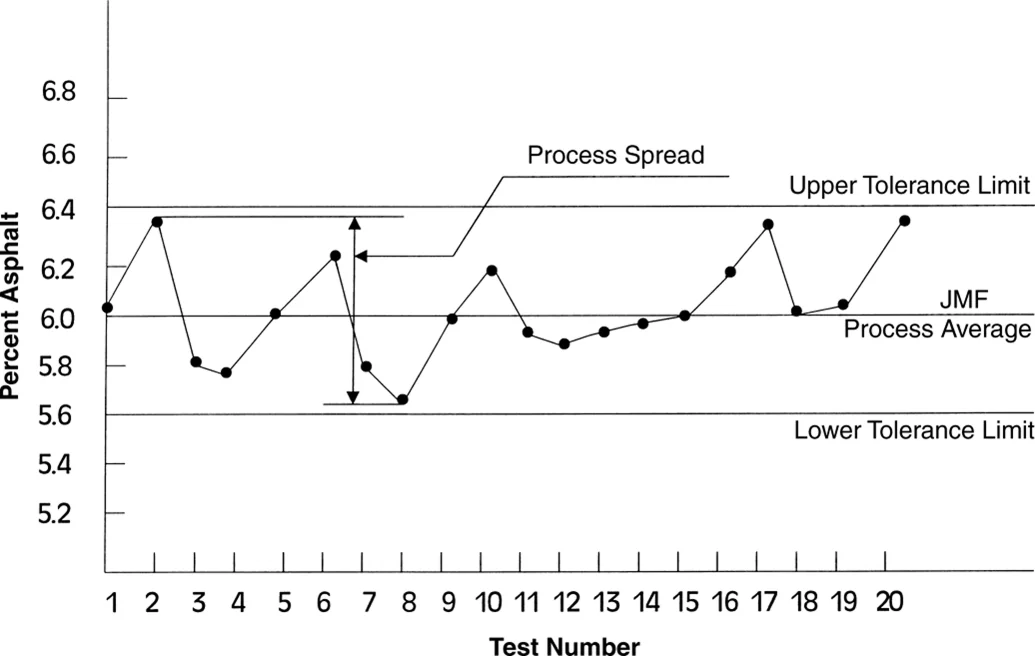
A final way plants can maintain control of the mixes they are producing is through regular monitoring of lab-generated control charts. Control charts are graphical plots of QC measurements or test results used to identify variation in a production or placement process, as shown in Figure 163. They can plot individual tests or moving averages. The specification limits may also be plotted, as in this example. The difference between the high and low result is the process spread (moving range), which should be minimized as much as possible.
Source: Hot-Mix Asphalt Paving Handbook 2000, 2nd Edition
Figure 163. Example Control Chart
Control charts can be an invaluable quick visual reference for spotting data trends and how close to the specification limits the test data are. A review of the example in Figure 163 shows that all the data fall within the specification limits. In this example, no discernible trend is evident. However, control charts are an excellent tool to reveal trends in production, such as test results that are consistently rising or falling over time. For example, a binder content that is consistently falling over time might reveal a blockage in the binder pump screen that is getting progressively worse. If results are consistently high or low, then the plant is producing at the wrong target, and adjustments must be made. Test results regularly above the upper control limit and below the lower control limit indicate high variability in the production process. The plant operator must actively address the issues that are preventing production of a consistent mix.
Control charts, especially for percent binder and gradations for each sieve, should be maintained and regularly shared with plant personnel. Continued monitoring of these test results is a valuable tool for ensuring the plant aggregate and binder feeds are at the targeted values. Control charts for other mix properties, such as air voids and VMA, are also important to maintain. If they begin to drift out of specification, the QC manager may need to investigate reasons why and then translate solutions into specific actions to be taken by plant personnel.
Roadway density control charts should be maintained and regularly shared with field supervisors. Tracking how the crew is achieving proper density will help the field supervisor use field personnel and equipment effectively.
Control charts are used by the contractor to decrease variability, establish process capability, reduce price adjustment costs, serve as a permanent record of quality, provide a basis for acceptance, and instill quality awareness.
All QC test data and control charts should be well documented and shared with agency personnel to ensure continued uniformity in testing between the two labs is maintained. If QC and agency test results begin to drift apart, immediate action should be taken to understand why the differences are occurring and take remedial action.
11.7 Quality Control In The Field: Placement And Compaction
QC tests and measurements should take place throughout the day during placement and compaction. The success of QC during placement depends on making corrections while the mix is hot and when a problem can be actively corrected.
11.7.1 Temperature Requirements
Because asphalt binder is a thermoplastic material, its properties change considerably with changes in temperature. Asphalt mixture is most workable and compactible when the material is hot. Most specifications have temperature requirements in several key areas.
11.7.1.1 Maximum Mixture Temperature
The asphalt mixture’s maximum temperature is often specified to avoid premature aging and oxidation of the mix. A typical maximum limit is 325 °F (163 °C). Sometimes the maximum limit is extended to 350 °F (177 °C) for polymer-modified mixtures. Of course, the limit is lowered when producing WMA to be used at cooler temperatures. The actual limit may be different for different WMA technologies. Contractors often use WMA technology as a compaction aid at HMA temperatures. This practice should not be discouraged because of the great importance of proper mat compaction.
The maximum temperature is best verified in a location close to where the mix is discharged, as soon as possible after mixing. A great location for drum-mix plants is the discharge chute from the drum to the slat conveyor, as shown in Figure 164. Infrared thermometers are the best tool for measuring temperature in this location.

Source: Asphalt Institute
Figure 164. Mix Being Discharged from the Drum
11.7.1.2 Minimum Temperature Immediately Behind the Screed
The loose mat’s minimum temperature immediately behind the screed is often specified to facilitate compaction. If a mat is too cool before the rollers hit it, it will be impossible to achieve proper mat density. A typical minimum limit is 250 °F (121 °C). It should be clearly understood that this temperature is a minimum, not a target. Again, the limit is often lowered when placing WMA.
The measuring location should be as close as possible to the back of the screed. Again, infrared thermometers are a great tool as long as a roller has not yet reached the measurement location. Roller drums are typically sprayed with a soapy water solution to keep the mix from sticking to the drum. This solution can lower the temperature of the extreme top surface of the mat and result in erroneous information from an infrared gun. If a roller has already made a pass over the measurement location, a stab thermometer will give the best results for the true mat temperature.
11.7.1.3 Minimum Ambient or Surface Temperature
An asphalt mixture will retain heat well while it is in the back of a truck. As discussed in Section 8.4.2, the heat dissipates rapidly once it is placed, especially with thinner lifts. This is one reason why paver operators should not speed up if several trucks are lined up in front of the paver, leaving roller operators behind. If the existing surface is already cool, the heat in the mix will dissipate even more rapidly. Most specifications have a minimum ambient temperature or a minimum surface temperature to facilitate the mat’s heat retention. Thicker mats retain heat better than thinner mats, so there is often a mat thickness component to the specification as well. Allowances may also be made for WMA versus HMA. As an example, Table 12 shows base temperature requirements from the FAA’s P-401 specification for airport construction.
Table 12. FAA Surface Temperature Specification

Source: FAA advisory circular 150/5370-10H (Table 4 of Item P-401)
11.7.1.4 Minimum Surface Temperature for Finish Rolling
An asphalt mat will remain compactible until the binder temperature becomes so low that aggregate in the mat begins to break under the finish roller. To protect the mat, many agencies specify a minimum surface temperature for finish rolling, often around 140 °F (60 °C). Because the job of the finish roller is to iron out any marks and achieve final smoothness, mat density should have already been achieved well before the mat temperature drops to this level.
11.7.2 Test Strips
Watch Video
Test strips, or “control strips,” are often constructed before beginning regular production paving for each asphalt mixture. Just as a trial batch ensures that the plant can produce a mix that meets specifications, a test strip ensures that the field crew can place and compact a mat that meets specifications. They also allow a second opportunity to verify the mix and the agreement of test results between labs. Test strips are composed of shorter lengths of pavement, typically 500–1,000 ft (150–300 m). The FAA control strip requirements for airfields are based on either tonnage (minimum 250) or 1/2 sublot, whichever is greater. FAA and DoD airfield test strips are also required to include two paving lanes with a longitudinal cold joint between them.
Just as a trial batch ensures that the plant can produce a mix that meets specifications, a test strip ensures that the field crew can place and compact a mat that meets specifications.
If possible, the test strips should be constructed on the project, with the same equipment and materials that will be used for the rest of the project. Some circumstances may warrant the test strip being placed in another location.
If the results of the test strip indicate the JMF is suitable for producing complying materials, and the appropriate spreading, placing, and compaction can be achieved, then production paving can proceed. If the results of the test strip do not meet project specifications, or if the typical existing cross-section changes, then adjustments can be made and a new test strip produced.
The following listing of placement controls should be closely monitored by the contractor:
- Tack coat application.
- Asphalt mix delivery rate.
- Paver speed.
- Paver adjustments.
- Grade control.
- Thickness control.
- Density control—
- Temperature of air and mixture.
- Roller type.
- Rolling pattern and coverage.
- Roller speed.
- Yield thickness control.
- Smoothness control.
11.7.3 Mat Density
Watch Video
The goal of compacting an asphalt pavement is to achieve proper density. The resulting in-place air void content of the asphalt mat is, in many ways, the single most important factor that affects the performance of the mixture throughout the life of the pavement.
The goal of compacting an asphalt pavement is to achieve proper density. The resulting in-place air void content of the asphalt mat is, in many ways, the single most important factor that affects the performance of the mixture throughout the life of the pavement.
Compaction is affected by many factors other than those specifically measured during placement of the mixture. This means that low density problems on a project may not be resolved simply by adjusting the rolling pattern or the temperatures. The QC manager and project superintendent may need to analyze all the QC data, including that from the mixture production, to address compaction problems.
In addressing a compaction problem, the paving crew must review their own operations and procedures for the placement and compaction operation, paying particular attention to temperatures and to having a disciplined adherence to good rolling technique and consistent and tested rolling patterns.
A variety of methods are available to control the quality of the compaction for an asphalt mixture. Those methods will be discussed in more detail below. These methods are usually driven by specification, however, so the QC will be based on the specified methods for acceptance of compaction. The QC efforts should be centered on establishing and documenting compliance with the actual specifications.
There are three ways to calculate compaction values, and they each give very different results. Compaction can be specified by the percentage of the TMD, the bulk laboratory density, or a control strip density. It is best practice, and most commonly specified, to measure density as a percentage of the TMD. For airfields, the FAA and DoD formerly specified density as a percentage of laboratory density, but the current P-401 and UFGS 32 12 13.15 specifications have moved to a percentage of theoretical maximum. The method specified should be clearly understood by both the agency and the contractor.
A common control method for compaction is to simply measure the in-place density. These measured densities will be compared with the specified reference density (typically TMD), and a percentage of the reference density will be calculated. Nuclear density measurements are the most common form of QC density testing for quick feedback to guide roller patterns. Non-nuclear devices have been developed and are gaining popularity for QC density testing. QC testing for density can also be done using cores; however, this imparts a delay in the results. Use cores to correlate and/or calibrate other test methods, especially if gauge readings are to be used for acceptance. Many agencies and gauge manufacturers have devised methods to properly correlate gauge readings to core results.
11.7.4 Mat Smoothness
Watch Video
Mat smoothness for QC and acceptance purposes is measured after compaction, typically with either a 10-ft straightedge (FAA and DoD specify 12-ft), a profilograph, or an inertial profiler.
Spot checks are typically done with the straightedge laid on the pavement and the deviation of the surface measured and recorded. Typically, no bumps or dips greater than 1/8 inch are allowed when measured from the two outer edges of the straightedge. Specifications usually require these measurements be taken in both the longitudinal and the transverse direction. By mounting a small set of wheels on the straightedge, spot checks can be performed immediately behind the finish roller while compaction is ongoing. This immediate feedback to the paver and the roller operators allows them to make the appropriate adjustments to correct smoothness issues before the mix cools. FAA requires that deviations greater than 1/4 inch that will trap water on the final surface in either the transverse or longitudinal direction be diamond ground and sealed.
The profilograph has historically been the method used to measure the roughness of new construction and overlay projects for acceptance. The profilograph is typically manually pushed along by the technician, requiring a lane closure for safety reasons. The use of this technology has waned in recent years as faster, more accurate inertial profilers are now preferred.
Inertial profilers can collect true pavement profile data and longitudinal distance data at highway speeds. Lightweight versions of the inertial profilers operate at slower speeds and can be used almost immediately after finish rolling to provide more timely measurements.
11.8 Acceptance
Acceptance is the process whereby all factors used by the agency (i.e., sampling, testing, and inspection) are evaluated to determine the degree of compliance with contract requirements and to determine the corresponding value for a given product. QC measurements may or may not be used in the acceptance decision process, depending on the way the specification is written. If the contractor’s QC measurements are used, the contractor is typically required to perform specific tests at stated frequencies.
The agency may also rely on supplier/vendor testing or certification for the acceptance of some items. All persons directly participating in acceptance activities must be qualified for their assigned responsibilities and are usually certified by the State DOT or airfield groups. Only qualified laboratories should perform the required tests.
QA specifications usually contain an acceptance plan that identifies a method of taking measurements for the purpose of determining the acceptability of a lot of asphalt mixture production and construction. The acceptance plan usually contains the following:
- Test method and point of sampling.
- Lot size.
- Sample size.
- Quality measure.
- Acceptance limits.
- Risk evaluation.
- Pay adjustment provisions (outlines pay deductions/bonuses).
11.8.1 Material Acceptance
There are often several components to how project work is accepted. Some work is not tested by QC or a representative of the owner. Certain products, such as lighting to be used on airfield runways, are accepted based on some type of manufacturer certification. Other products, like asphalt mixtures, are sampled and tested for acceptance. Specified tests may include some or all of the following:
- Asphalt content.
- Gradation (usually specific sieve sizes).
- Volumetrics (air voids, VMA, VFA).
- Performance tests (for rutting, cracking potential).
- Mat density tests (cores, nuclear density gauge, non-nuclear density gauge).
- Smoothness.
Specified testing (and thereby testing costs) should be relative to the project size and/or importance. Smaller projects may specify very few tests at infrequent intervals to help ensure the owner is receiving a quality product without spending too much relative to the project cost. Larger projects, or even smaller projects assigned a high level of importance for various reasons, will typically require a greater number of tests at more frequent intervals.
11.8.2 Responses to Failing Test Results
Contract language often falls short when the consequences of work not meeting contract requirements are not detailed. The responses could vary widely, depending on what work is out of specification and by how much. Potential responses, ranging from least to most expensive, could include the following:
11.8.2.1 Do Nothing
An owner may elect to do nothing in response to out-of-specification work if the anticipated functionality would have no long-term detrimental effect. For example, if the binder content is too low on a temporary crossover. If the crossover functions by safely moving traffic from one area to another for the planned duration and is then removed, there is no reason to apply any type of penalty for a low binder content. It is not necessarily reasonable to apply requirements for asphalt mixtures intended to last 20 years to asphalt mixtures intended to last 6 months.
11.8.2.2 Leave in Place but Require an Extended Warranty
This option may be viable when the anticipated effects of out-of-specification material reveal themselves in a relatively short time, perhaps within a few months or years. An example of this is a mixture meeting rut testing requirements during mix design but failing rut testing requirements during required QC or acceptance testing during production. Most rutting that occurs on a mat will happen during the first summer of service. Any additional rutting will likely take place during the second summer of service. Therefore, a 2-year warranty outlining maximum rut allowances and required contractor responses to repair the issue would likely serve the interests of the owner. Because cracking typically occurs later in the mat service life, this may not be a good option for failed cracking tests.
11.8.2.3 Grind Rough Areas So They Meet Smoothness Requirements
Rather than applying a penalty, contractors are sometimes allowed to diamond-grind rough areas that cause failures in the smoothness specifications. For example, for airfields, P-401 says that areas with humps or depressions that exceed grade or smoothness criteria and that retain water on the surface must be ground off, provided the course thickness after grinding is not more than 1/2 inch (12 mm) less than the thickness specified on the plans. Of course, the grinding work must be done with appropriate equipment and enough blades to keep the process from causing raveling, aggregate fractures, spalls, or other pavement distress. It must also provide smooth transitions to areas that did not require grinding.
11.8.2.4 Deduct Pay
A more severe penalty for results not meeting specifications is a pay deduction. In statistically based specifications, the MOQ is any of several mathematical tools that are used to quantify the level of quality of an individual quality characteristic. These tools, such as AAD and PWL (discussed in sections 11.2.3.1 and 11.2.3.2), allow an assessment of test data showing defective results. The pay adjustment provision in the contract penalizes the contractor a percentage of the bid cost. The further out of specification, the higher the penalty. The worst-case pay deduction is to leave the material in place but assess a 100-percent pay deduction.
11.8.2.5 Place Surface Seal or Thin Overlay
This option does not penalize the contractor by lowering the percent paid on a particular bid item. Rather, it requires the contractor to do some type of extra work at no expense to the owner. This option might be pursued if the surface of the mat had some type of defect that was not structural. Perhaps the surface might appear to have an open texture, and field permeability testing showed high permeability where it was not desired. Surface sealing would lower the permeability of the mat. Another example might be that the contractor did not use a specified skid- or polish-resistant aggregate in the surface mix. A thin overlay would provide a new wearing surface. The contractor might place one of these surface types at no cost if the penalty for not doing so exceeded the cost of the new surface.
11.8.2.6 Remove and Replace
This option is the harshest penalty that owners could assess. If the work quality is so poor that the owner would incur high costs to rehabilitate or maintain it, the order would be given to remove the work and replace it—all at the contractor’s expense. Not only is there a 100-percent penalty for the first attempt at the work, but there is also the additional cost of doing it all again.
It would be best if the situations leading to these punitive actions were clearly described in the contract documents. Both the owner and the contractor would clearly understand the ramifications of any substandard work. If the situations were not agreed to in the contract, legal action is often pursued, which could be costly to both parties.
It should also be noted that the opposite is true: many specifications provide incentives to the contractor for measured quality above a prescribed threshold. These incentives most often come in the form of some type of bonus pay but can also come in the form of relaxed requirements in related areas of the specifications.
11.8.3 Project Acceptance
The focus of QC is material acceptance. However, when the project work is essentially complete, a final inspection takes place regarding final project acceptance. The completion of major tasks is verified and a punch list of relatively minor tasks to be completed is generated before the project is accepted.
A final estimate is generally produced to reflect items remaining to be resolved, such as the following:
- Agreement of price reductions assessed for work or materials not meeting contract specifications.
- Incentives to be paid for qualifying work or materials.
- Liquidated damages assessed for failure to complete project work within a specified timeframe.
- Payroll records, if required.
- Copies of any manufacturer’s warranties for materials, equipment, and installations.
- Verification of final cleanup.
- Complete release of all claims for labor and materials.
- Statements signed by subcontractors indicating payment was received.
- Sales tax completion forms.
- All required as-built or as-constructed drawings.
- Any other adjustments as required by the contract.
Project acceptance is simply the process of making sure the project activities and paperwork are complete—that every detail is meticulously addressed so that no further payment or correspondence is required between owner and contractor.