
7. Mix Placement
7.6 Establishing Paver Speed
Planning is necessary for constructing a high-quality asphalt pavement, and it begins by coordinating the amount of material needed, the number of trucks needed, and the amount of compaction needed before the mix temperature falls below compactible levels. Uniform paver speed is essential to keep the paving plan intact. The paver operator must be trained to monitor the arrival rate of the material, the flow of material through the paver, and the pace of the compaction train and try to keep all three operations in balance. The paver operator’s main goal should be to maintain a pace consistent with the pace of the compaction train and not worry about surges of delivery trucks arriving in front of the paver. By releasing trucks from the paver in an orderly manner, the paver operator can help maintain spacing of trucks returning to the plant.
To balance a paving operation that provides continuous forward motion and uniform pavement placement, calculations must be made to estimate the following:
The number of trucks needed to deliver mix.
The paving speed.
The production capacity of the compaction train.
A perfectly balanced mainline highway paving operation will run continuously, without interruption, at the same rate of production as the asphalt plant. The number of trucks required is covered in Section 6.2 and is assumed to be sufficient for continuous operation for the following example.
Calculating Paver Speed
Assumptions:
Plant production = 350 T/hr
Compacted unit weight = 150.2 lbs/ft3
Compacted lift thickness = 2.0 inches
Paving width = 14 ft
Determine the spread rate:

Or directly calculate tons per linear foot of mix:

1 ton of mix will cover:

The distance paved in 1 hour equals:

Calculate paving speed in feet per minute:
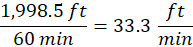
This calculation is a theoretical number that assumes continuous operations with no paver stops. If paver stops are anticipated, then they should be factored in via an efficiency factor. Maintaining the same production rate per hour will require the paver to move faster. If it is anticipated that the paver will be moving 90 percent of the time, this should be accounted for with an efficiency factor of 0.90, as shown below:
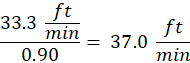
One can see that even if the paver is down 10 percent of the time, it does not take a large increase in ground speed to make up the lost time. If the compaction production rate (covered in Section 8.5.2) is not able to keep up with a calculated paving speed, the paver speed and plant production will need to be reduced or additional rollers added to maintain production and achieve the specified density.