
10. Segregation
10.3 Four Stages Where Segregation Can Originate

Watch Video
Segregation most commonly occurs at these four stages:
- Aggregate handling and stockpiling.
- Asphalt plant production.
- Trucking operations.
- Paver operation.
Segregation caused by the trucking and paving operations can generally be noticed by the paving crew, foreman, or inspector, and corrections can be made quickly. Conversely, segregation caused by aggregate handling and mix production may be more complex to pinpoint and therefore may not be corrected on the day the segregation was noticed.
The following sections address each of the four stages.
10.3.1 Aggregate Handling and Stockpiling
Stockpiles can be built properly, with minimum segregation, by end-dumping the aggregate from trucks to form piles that are only one layer deep. The challenge with this method is that it requires a lot of space since the stockpiles are not high.
Tall, conical stockpiles of aggregates should be avoided because coarser particles tend to roll down the sides of the pile. Stockpiles constructed in layers or material inclines with less than 30 percent slopes are preferred.
10.3.2 Asphalt Plant Production
Segregation issues in the asphalt plant are beyond what the paving crew at the jobsite can solve. Given the complexity of the asphalt production facility, the many locations where segregation may occur will require a lengthy investigation by contractor plant maintenance personnel and possibly the manufacturer’s technical assistance.
One of the most common causes of plant segregation is improper loader operation at the plant, which can contribute significantly to sporadic nonuniform segregation. Loading cold-feed bins from segregated stockpiles, placing the wrong material in the wrong bin, allowing the aggregate in the cold-feed bin to bridge (thereby halting the feed from that bin), or letting bins run dry will produce segregation in the mat behind the paver.
The following are additional locations in the mix production facility that may need to be looked at to ensure a uniform flow of material through the plant:
- Cold bins.
- Hot bins.
- Drum dryer flights.
- Hot elevator.
- Pugmill and bin gates.
- Surge and storage bins.
- Discharge systems.
Broken or poorly maintained equipment may require repair, fabrication, or even retrofitting plant equipment.
10.3.3 Trucking Operations
Segregation occurring due to the truck loading and unloading can typically be observed by field personnel and corrected quickly.
Asphalt mix can segregate as it is loaded into trucks from either the pugmill, silo, or surge systems. Trucks are much larger today, and care should be taken during loading to prevent coning within the truck bed.
Pugmills, silos, and surge systems all have the same truck loading recommendations. There should be at least three drops of material—front, back, and then center (see Figure 76 in Chapter 6). A single discharge into the truck allows larger particles to segregate. The mix should be placed first near the bulkhead to produce a stacking effect for the front and sides. The second drop produces the same conditions at the rear of the truck. The third drop, in the middle, should overlap the conical sides of the first two. This procedure does not eliminate segregation entirely but spreads it out and minimizes the effect.
The method used to unload the haul truck into the paver hopper may also contribute to segregation by generating longer slopes over which the particles may separate during dumping. Most problems of this kind develop from slowly raising the truck bed while dumping. When the truck is in place to dump into the hopper, the bed should be partially elevated before the tailgate is released. This permits the mix to move in mass and to flood the hopper, thus preventing the coarse aggregate from trickling out first and causing spotty segregation patterns.
10.3.4 Paver Operation

Watch Video
The paving operation is more than just knowing how to operate the equipment. Many mistakes in handling the mix in the hopper and in the auger compartment, and in operating the screed, can cause non-correctable segregation in the finished mat. The cause of such segregation should be corrected as soon as it is observed. If the cause cannot be identified and the segregation persists, the paving operation should be halted.
In the ideal paving operation, the paver should move forward at a constant speed all day without stopping and starting. However, some incidental stopping and starting is unavoidable. When this happens, both physical and thermal segregation is minimized by making a hard stop with sufficient mix in the hopper and in the auger chamber at the correct mix height. If the interruption in paving is expected to take too long (typically more than 30 min), actions comparable to what is done at the end of the paving day need to take place and a transverse joint created.
If segregation does occur during paving operations, the following are common causes.
Causes of segregation in the hopper:
- The hopper is allowed to be emptied below 1/3 of the hopper’s capacity.
- The hopper wings are folded at frequent intervals.
- The slat conveyors are allowed to be starved of mix and become visible.
- The flow gates are set incorrectly for the speed of paving.
- Spilled mix is being returned to the hopper.
Causes of segregation in the auger chamber:
- The mix is not kept at a constant height and at the same level as the auger axle across the full width of the screed (see Figure 158).
- The height of the mix differs between the left and right side.
- If paving wider, the augers and the confining tunnel are not extended close to the end gate.
- The augers are not set high enough to allow reverse flow under the auger gearbox.
- The reverse augers near the auger gearbox are not present or working.
- The rotation speed of the augers is not within acceptable limits.
Any of the issues listed above have the potential of causing segregation.
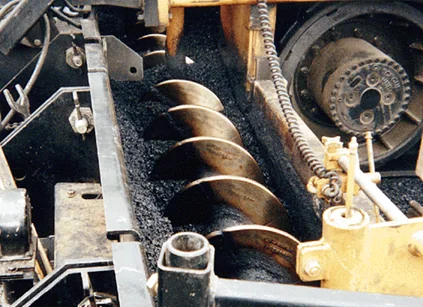
Source: Reway
Figure 158. Proper Mix Height in the Auger Box
Continuous segregation can generally be attributed to operations and material handling at the paver. Regular spacing of segregated areas is typically end-of-load related.