
7. Mix Placement
7.5 Layer Thickness

Watch Video
After asphalt material is spread and struck off by the screed, it is in a “loose” state even though it has received some initial compaction from the tamper bar or vibratory screed. It is critical that the thickness of the loose mixture after it has been placed is sufficient to allow for consolidation through the compaction process so that the final thickness meets the thickness specified in the project plans.
To accomplish this, a rolldown factor for each material must be considered. This factor varies depending on mixture type, with a common rolldown factor (for a typical dense-graded mix) being approximately 25 percent (see Figure 109). For instance, assuming a 25-percent rolldown factor on a 2-inch compacted lift thickness, the thickness placed by the paver must be 25 percent thicker or 2.5 inches thick. When gap and open-graded materials are being placed, a rolldown factor of about 15 percent is probably more accurate. During paving operations, it is a best practice for the screed operator to regularly measure the thickness of the loose mat directly behind the paver. When necessary, adjustments to mat thickness should be made to ensure that the proper amounts are being placed. A more in-depth discussion regarding the construction of transverse joints at startup is discussed in Chapter 9, Section 9.2.2.
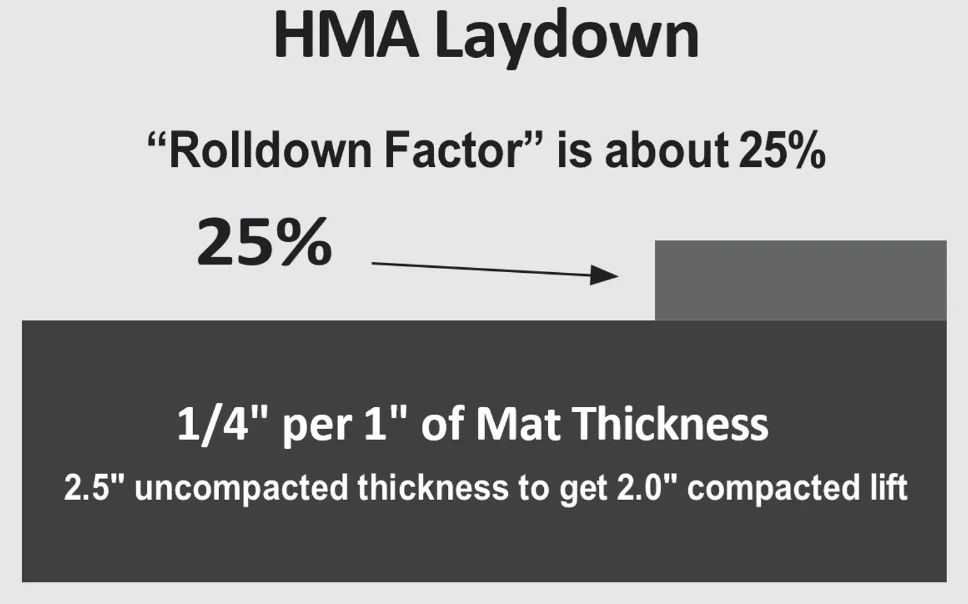
Source: Asphalt Institute
Figure 109. Rule of Thumb Rolldown Factor for Dense-Graded Mixtures
Spread rate is a useful calculation that onsite inspectors and paving foremen can use to confirm the paver is set up properly and placing the proper amount of material. It is based on the unit weight information from the lab and is expressed in terms of pounds per square yard of material for every inch of compacted thickness. These units are typically expressed as lbs/yd2-inch.
The formula for spread rate is as follows:

With this factor, quantities can be readily calculated as follows in any number of terms based on the width, feet, and the depth and compacted inches for a given distance:
Tons/linear foot (T/LF), which is useful determining tonnage to move a paver a certain distance.
Tons/project station (T/sta) to compare quantities with the project plan sheets.
Tons/mile (T/MI) to compare with overall contract quantities.