
2. Project Organization
2.4 Ongoing Communication

Watch Video
Communication cannot stop once the preconstruction conference has finished. The quality of the paving work, along with the safety of those performing and inspecting the work, is directly related to the quality of the ongoing communication between all parties involved. It is important that the individuals in daily charge of the project for both the agency and the contractor meet periodically, on both a formal and an informal basis, to discuss the progress and quality of the work done to date and the schedule for future work. Clear lines of communication should be established, as illustrated in Figure 2, with regards to QC.
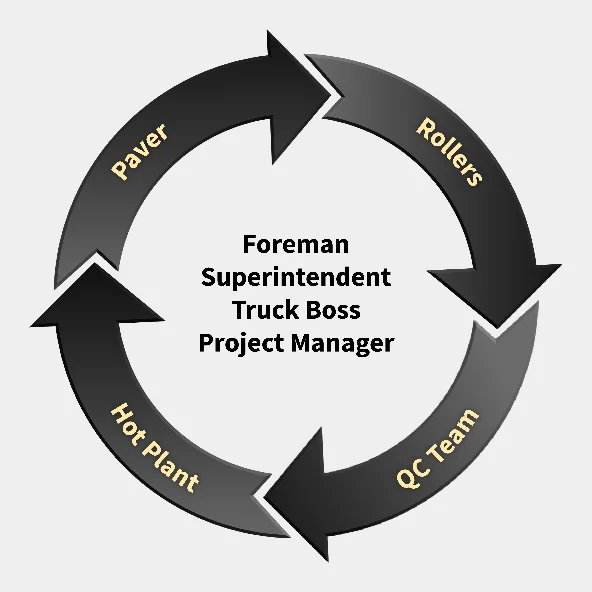
Source: National Asphalt Pavement Association
Figure 2. Lines of Communication for Quality Control
2.4.1 Formal Meetings
The frequency of formal update meetings depends on the scope and the size of the paving job. On a major project, these should be held at a regularly scheduled time at least once weekly, such as every Monday morning at the project office. Key personnel from both the agency and the contractor should be present, and an updated “look ahead” schedule should be presented and discussed so that all parties can properly plan and coordinate. The meeting should be conducted jointly by the agency and the contractor and serve as a forum for constructive input to the job. Written meeting minutes should be taken and distributed to interested parties.
The discussion should include such items as the quantity of work completed and test results obtained. The meeting should also focus on what has yet to be accomplished and the schedule for the coming weeks. Any changes in personnel, equipment, construction methods, and JMF should be discussed. Problems that have arisen and those that are anticipated should be communicated to both parties, with solutions explored. Safety should also be reviewed.
2.4.2 Informal Meetings
Informal meetings should be held daily between the individuals in charge of the job for the agency and the contractor. Ideally, these meetings should occur at a regularly scheduled time and can be held at the asphalt plant or at the paving site. The purpose of these informal meetings is twofold. First, occurrences the day before such as work completed, test results, and any problem areas encountered should be discussed and resolved, including overall safety issues. Second, the discussion should address what is expected to happen that day and over the next few days. Various aspects of the overall safety plan and specific project hazards should be included in these daily meetings. Providing key takeaways from any recent formal meetings is also important.
Asphalt paving projects, like many construction projects, are not always conducted as originally scheduled. Changes occur because of problems with material supply, equipment breakdown, contractor and subcontractor schedules, and weather conditions. When such changes occur, it is important that they be communicated between the contractor and the agency. Daily informal meetings provide a forum for the exchange of such information. The team also needs to appreciate that paving projects are uniquely dynamic: work zones are mobile and bustling with dozens of pieces of moving equipment, including trucks entering and exiting, and are often spread out over thousands of feet.
Section 2.6 includes additional discussion on daily safety briefings.
2.4.3 Communication Formats
Communications can be oral, electronic, and written. Much information can be communicated in oral form, but discussion of important information, including a change of conditions or contract modifications, should be in writing. Issues should be resolved quickly so they do not hamper the project schedule and risk project costs, efficiency, or safety.
Personnel for both the agency and the contractor should keep daily diaries and photographs of events that occur. Occurrences noted in a daily diary may need to be remembered later, and a written log can help keep the details accurate and complete. Section 2.5 contains a more thorough discussion of daily diaries.
Electronic project management tools are available to help with project communication and necessary project documentation.