
AAPTP
  • Small
  • Medium
  • Large
  • Small
  • Medium
  • Large
  • Home
  • Handbook
    • Asphalt Paving Handbook
    • Videos
    • Figures
    • Tables
  • Checklists
  • Abbreviations
  • About
  • HOME
  • Handbook
    • Asphalt Paving Handbook
    • Videos
    • Figures
    • Tables
  • CHECKLISTS
  • ABBREVIATIONS
  • About
1. Introduction
  • 1.1 Handbook Purpose and Organization
  • 1.2 Airfield Paving
  • 1.3 Asphalt Mixtures Defined and Classified
  • 1.4 Workmanship
  • 1.5 Certification and Accreditation Programs
2. Project Organization
  • 2.1 Introduction
  • 2.2 Project Documents
  • 2.3 Preconstruction Conference
  • 2.4 Ongoing Communication
  • 2.5 Ongoing Records
  • 2.6 Safety
3. Asphalt Materials and Mix Design
  • 3.1 Introduction
  • 3.2 Asphalt Binder: Grading Systems And Properties
  • 3.3 Aggregate Characteristics And Properties
  • 3.4 Mixture Volumetrics
  • 3.5 Asphalt Mix Properties
  • 3.6 Additives
  • 3.7 Mix Design Procedures
  • 3.8 Laboratory Versus Plan-produced Mixes
  • 3.9 Summary
4. Mix Production
  • 4.1 Introduction
  • 4.2 Material Storage and Handling
  • 4.3 Aggregate Cold Feed
  • 4.4 Aggregate Drying and Heating
  • 4.5 Batch Plants
  • 4.6 Drum and Continuous Plants
  • 4.7 Emission-Control System
  • 4.8 Temporary Mixture Storage
  • 4.9 Weighing and Loadout
  • 4.10 Safety
  • 4.11 Troubleshooting and Checklists
5. Surface Preparation
  • 5.1 Introduction
  • 5.2 Base Preparation for New Asphalt Pavements
  • 5.3 Asphalt Surface Preparation for Asphalt Overlays
  • 5.4 PCC Surface Preparation For Asphalt Overlays
  • 5.5 Tack Coat
  • 5.6 Summary
6. Mixture Delivery
  • 6.1 Introduction
  • 6.2 Planning
  • 6.3 Truck Types
  • 6.4 Proper Truck Loading
  • 6.5 Hauling Procedures
  • 6.6 Unloading the Mix
  • 6.7 Tracking Quantities
7. Mix Placement
  • 7.1 Introduction
  • 7.2 Tractor Unit
  • 7.3 Screed Unit
  • 7.4 Grade Control
  • 7.5 Layer Thickness
  • 7.6 Establishing Paver Speed
  • 7.7 Related Paving Operations
  • 7.8 Best Practices Checklists
8. Compaction
  • 8.1 Introduction
  • 8.2 Definitions
  • 8.3 Rollers
  • 8.4 Factors Affecting Compaction
  • 8.5 Compaction Variables Under The Operator’s Control
  • 8.6 Determination of Rolling Pattern
  • 8.7 Roller Checklists
9. Joint Construction
  • 9.1 Introduction
  • 9.2 Transverse/Construction Joints
  • 9.3 Longitudinal Joints
  • 9.4 Echelon Paving and Rolling
  • 9.5 Unconventional Longitudinal Joint Methods
10. Segregation
  • 10.1 Introduction
  • 10.2 Recognizing Physical Segregation, Causes, and Solutions
  • 10.3 Four Stages Where Segregation Can Originate
  • 10.4 Thermal Segregation
  • 10.5 Confirming and Quantifying Segregation
11. Quality Assurance
  • 11.1 Introduction
  • 11.2 Definitions
  • 11.3 General Types Of Specifications
  • 11.4 Quality Control Plan
  • 11.5 Sampling Methods
  • 11.6 Quality Control At The Plant
  • 11.7 Quality Control In The Field: Placement And Compaction
  • 11.8 Acceptance
12. Mat Problems
  • 12. Mat Problems
  • 12.1 Surface Waves
  • 12.2 Tearing (Streaks)
  • 12.3 Nonuniform Texture
  • 12.4 Screed Marks
  • 12.5 Screed Responsiveness
  • 12.6 Surface (Auger) Shadows
  • 12.7 Poor Precompaction
  • 12.8 Joint Problems
  • 12.9 Checking
  • 12.10 Shoving And Rutting
  • 12.11 Bleeding And Fat Spots
  • 12.12 Roller Marks
  • 12.13 Poor Mix Compaction
  • 12.14 Other Pavement Problems
Appendix
  • AAPTP Airport Asphalt Videos

6. Mixture Delivery

6.2 PLANNING

Youtube Video Icon

Watch Video

Yield Calculations

The planning process for a paving job includes determining the number of trucks needed and ensuring the truck drivers are properly trained. The size and types of available trucks, the time to make one trip from the plant to the paver and back (known as cycle time), the planned hourly plant production rate, the length of the paving shift, and any mixture stored at the start of the workday are all details that should be considered by the paving contractor to properly plan their trucking needs. Also, drivers should be trained in their proper role in loading at the plant, hauling, and unloading at the paver to minimize segregation, ensure safety, and promote continuous paving.

The cycle time includes all steps that are a part of a complete cycle. This may include time to load and ticket the truck, tarp the load, haul it to the paving site, wait onsite to unload, dump and clean, and return to the plant.

If a shift begins with paving material stored in a silo, that material effectively adds production capacity for the contractor. The amount of added capacity is determined by the amount stored and the shift length. For example, if a 10-hr shift begins with 250 tons of mixture in a silo, this equates to 25 tons/hr (250 tons/10 hr) of additional production capacity. Thus, the true production will be the tons/hour produced by the plant plus the added tons/hour supplied from the silo.

Determination of the required minimum number of trucks is an important aspect of planning for an asphalt paving project. The items stated above are needed to properly estimate this requirement. The minimum number of trucks needed can be calculated by the following equation:

Where:
T = tons
hr = hours
min = minutes

The answer is always rounded up. For example, if the equation yields 13.1 trucks, a minimum of 14 trucks will be needed.

EXAMPLE

Determine the minimum number of trucks for a job with the following information:

Plant Production =250 T/hr (227 tonnes/hr)
Silo Charge at Start of Day =200 T (180 tonnes)
Shift Length =10 hr
Truck Capacity =20 T (18 tonnes)
Load Time and Ticketing =4 min
Tarping Time =2 min
Haul to Jobsite =35 min
Time on Site =4 min
Dump and Clean =4 min
Return Haul =35 min

Step 1: Determine True Plant Production Rate

This will be the added production rate from the use of the materials stored in the silo at the beginning of a shift plus the plant production rate. In this example, 200 tons are stored that will be used over a 10-hour workday.
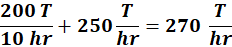
Step 2: Determine the Total Cycle Time

The total cycle time will be the sum of each of the steps encountered from the loading to the return of a single truck: 84 min in total.

Step 3: Calculate the Total Trucks Needed:

This number should always be rounded up. Therefore, 19 trucks will be needed to maintain a proper flow of mix to the jobsite.

The time interval between each delivery should be consistent, and the trucks should not be allowed to bunch up at the paver or at the plant. If a break in the delivery of material occurs, the paver contractor should stop the paver using a rapid stop technique and then use a rapid start when enough trucks are on the jobsite. This method will promote continuous paving. Starting and stopping the paver for each truck as it arrives on the project will reduce the smoothness and quality of the finished pavement and negatively affect the density of the mat.

Starting and stopping the paver for each truck as it arrives on the project will reduce the smoothness and quality of the finished pavement and negatively affect the density of the mat.

Previous Section
Next Section

© National Asphalt Pavement Association (NAPA). All rights reserved|Privacy Policy

6406 Ivy Lane, Suite 350 Greenbelt, Maryland 20770-1441

|888-468-6499
  • LinkedIn
  • Facebook
  • Twitter
  • YouTube
  • Instagram
Information

There are no items associated with the selected chapter.