
10. Segregation
10.1 Introduction

Segregation is the physical and/or thermal nonuniformity of an asphalt mixture. Segregation is a construction defect and is detrimental to the performance of the pavement.
Segregation is a construction defect and is detrimental to the performance of the pavement.
Physical segregation is simply a nonuniform distribution of aggregate particles within an asphalt mixture. Areas of mix placed with concentrations of larger particle sizes will have larger air voids after compaction, which are likely interconnected, causing the compacted mat to be permeable.
Thermally segregated mix can meet mix design parameters but suffer from thermal differentials within a freshly placed mat that results in nonuniform and poor compaction.
Where segregation occurs, the finished mat will have a varied texture and may not meet specification requirements for surface texture, smoothness, or density. Segregated areas differ from the approved mix design, and the areas will not meet the required volumetric properties.
Segregation is typically understood to be physical segregation, therefore thermal segregation should be explicitly identified as such in discussions and text.
10.1.1 Reasons for Segregation and Consequences
The ratio of weight to surface area of a large aggregate particle is greater than that of a small aggregate, and therefore large aggregates tend to be more prone to migrate away from the mass. This migration of aggregate is typically the result of gravitational forces while the aggregate is in motion. Thus, physical segregation occurs when aggregates are being stockpiled and the larger aggregates tumble down the outside of the pile, leaving the smaller aggregates behind. Somewhat similar behavior occurs when a mix is dropped in storage silos, in truck loading and unloading, and in the paving machine when the mix is being pushed forward without confinement. These activities allow the largest aggregate in the mix, even while coated with binder, to migrate.
Physical and thermal segregation result in reduced density, a higher percentage of air voids, and mat permeability. Air and water intrusion will cause disintegration of the compacted mix. With time this results in early pavement failures and, on airports, the occurrence of FOD. The consequence is early maintenance with localized fixes or, depending on the extent and severity, complete removal and replacement.
Permeability testing of compacted mixes can determine the critical percentage of air voids at which the air voids become interconnected, allowing air and water intrusion into the mat. For dense-graded 1/2- and 3/4-inch NMAS mixes, the air voids typically become interconnected at or above 8 percent. For larger NMAS mixes, this transition to being permeable will occur at even lower air void contents. Permeability increases as NMAS increases and density decreases.
10.1.2 Locations Where Segregation Can Originate
Segregation is prone to occur most often at five stages: aggregate handling, mix production, mix storage, trucking, and laydown. Areas where handwork is required are also easier to segregate. Careful observation and control of mixing and placing operations during these stages can reduce or eliminate segregation in most asphalt mixes. The economic benefit of reducing or eliminating segregation has been universally recognized, and agencies that specify asphalt pavements are increasingly addressing ways to control segregation.
Some mixes are more prone to segregation than others, so designers should consider the propensity for segregation of a particular mix. Asphalt mixes that have large-sized coarse aggregate or have low asphalt binder content or are gap-graded will tend to segregate more than a dense-graded mix containing higher asphalt contents and smaller-sized coarse aggregate.
When segregation is observed, there are many process locations to inspect. The inspection starts with aggregate handling and stockpiling, then the many details of the mix production facility, the storage silos and batchers, the truck loading and unloading procedures, and finally the paving machine operations. There are many steps in the mix production process that remix materials to help alleviate mix segregation.
The practice of excessively raking the mat edges and joints should be minimized, as this can also cause segregation.
10.1.3 Early Opportunity to Observe and Correct
Physical segregation is typically first recognized visually in the paved mat. This is when early action is needed to avoid continuation of the problem. Cause(s) need to be determined and adjustments made. Identifying causes and correcting segregation in the mat is a process of working backward: from the paving process, to trucking and loading, to mix storage, to mix production, to aggregate handling.
At the paver screed, a check should be done to ensure the mix is handled correctly by the augers. When paving wide without proper auger and tunnel extensions, the mix tumbles due to lack of support, and segregation potential increases significantly (see Figure 150).
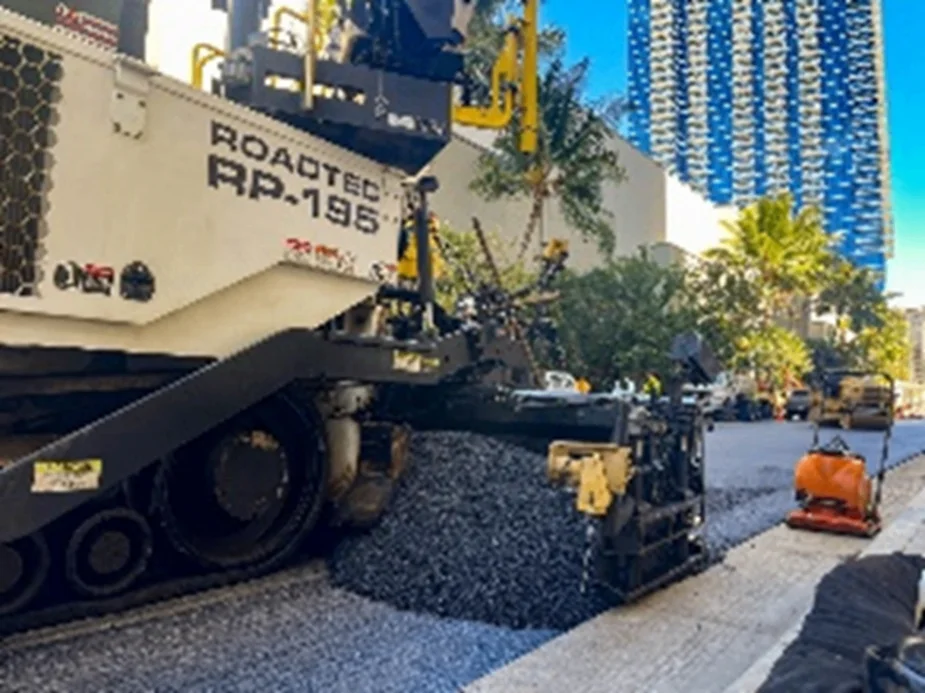
Source: Hawaii Asphalt Paving Industry
Figure 150. Improper Auger and Tunnel Extensions Cause Segregation
At the paver hopper, the hopper should be kept at least 1/3 full, above the top of the slat conveyor tunnel opening(s).
The hopper wings should only be folded at the end of the paving shift. The mix caught in the corners should be left so that all newly deposited mix keeps flowing without being caught in dead corners of the paver hopper.
The use of an MTV can help eliminate both the physical and thermal segregation that occurs before the mix reaches the paver. Dumping mix from a truck directly into a paver hopper can cause segregation, especially over time. MTVs that convey mix directly into a hopper insert will reduce the potential for segregation in this area of the paver. Windrow elevators can also be used for remixing, as discussed in Section 7.2.3.
The use of an MTV can help eliminate both the physical and thermal segregation that occurs before the mix reaches the paver.
Recognizing the many possible segregation opportunities at the mix production facility is the responsibility of the plant operator and inspector and the contractor, and it may also require involvement by the equipment manufacturer.
Incorrect milling that leaves scabs behind (especially for thinner paving lifts) can cause segregation because of fluctuations in how the mix flows under the screed. Overlay lift thicknesses less than three times the NMAS are prone to segregation when placed on a milled surface. In addition, poorly processed RAP that contains oversized agglomerations of material can inhibit smooth and uniform mat placement.