
12. Mat Problems
12.10 Shoving And Rutting
12.10.1 Description
Shoving of an asphalt layer is displacement of the mixture in a longitudinal direction. Such displacement may take place during the compaction operation or later under traffic. In most cases, shoving during construction is accompanied by a large bow wave in front of the breakdown roller, particularly if that roller is a vibratory or static steel-wheel machine. Shoving may also occur in conjunction with mix checking if the mix is tender enough because of faulty aggregate gradation or excess fluids (asphalt binder or moisture) content. Finally, mat or mix shoving can occur at the reversal point of the rollers, especially at the location closest to the paver. A pavement layer that has shoved under the action of traffic is shown in Figure 169.
Rutting, illustrated in Figure 170, shows displacement of the mixture in both vertical and transverse directions. Rutting occurs when heavy traffic passes over an unstable mix. In a few cases, the rutting is purely vertical (consolidation rutting). In this situation, the mix (or underlying materials) was not adequately compacted at the time of construction, and the traffic loads are essentially finishing the compaction process. The most common form of rutting is transverse distortion—the mix distorts or shoves transversely as a result of lateral flow of the mix under applied traffic loads.

Source: Asphalt Institute
Figure 169. Shoving Due to Unsatisfactory Mix
12.10.2 Causes
Shoving and rutting are due primarily to an unstable mixture (see Chapter 3). This instability can be caused by the same variables that are responsible for checking—an excess of fluids (asphalt binder or moisture) in the mix, a hump in the fine aggregate grading curve, or the properties of the aggregate and the asphalt cement. Shoving and rutting can be highly prevalent when a sand mix is placed in a thick layer (more than 1-1/2 inch [40 mm]) at a high temperature (more than 280 °F [140 °C]). Further, thicker lifts of an unstable mix in proportion to the maximum aggregate size used will tend to shove more than thinner lifts with the same aggregate size and grading.
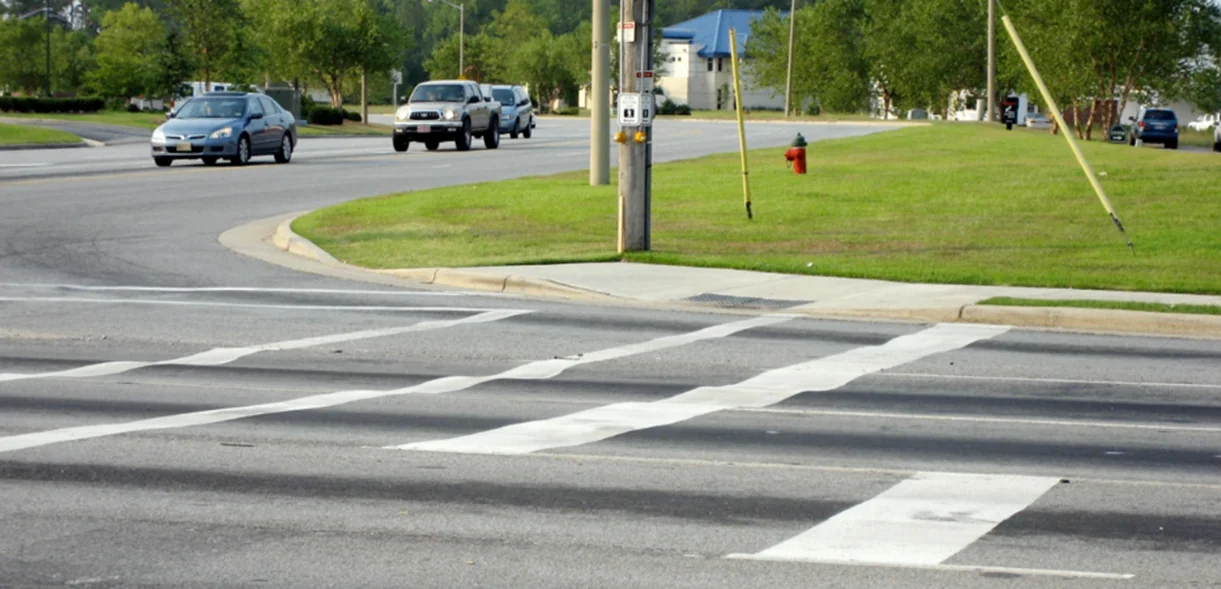
Source: East Carolina University
Figure 170. Rutting of Unstable Asphalt Mixture
Improper roller operation, particularly the sudden reversal of the roller, can also contribute to the shoving of the mix during construction (see Chapter 8). If a vibratory roller is run at too great a speed and the impact spacing is too far apart, the mat may develop a washboard effect, where the peak-to-peak distance is equivalent to the impact spacing. Washboarding, or shoving, is more likely to occur at normal frequencies but at high speeds where the impact force is greater. If a pneumatic tire roller with high tire pressure is used for breakdown compaction, a tender mix may shove laterally under the tires. Shoving can occur under any roller that is operated improperly.
Another possible cause of shoving is an excess of tack coat material that may be pulled into the mix. In a similar manner, excess asphalt from a bleeding underlying surface or from joint filler material can be pulled into the mix and increase its fluidity and tenderness. Shoving may occur as well when the underlying surface is dusty or dirty—a slippage failure (see Section 5.5).
12.10.3 Solutions
The solution to a mix that shoves under the compaction equipment is to increase its internal stability. This can be accomplished by reducing the fluids content (asphalt or moisture, or both) of the mix, but only after determining the effect of a change in asphalt binder content on the mechanical properties of the mix. The internal friction can be increased by lowering the mix temperature. Alternatively, the internal friction among the aggregate particles can be increased by changing the aggregate gradation or increasing the amount of angular (crushed) particles in the mix.
The compaction process for a tender mix should be changed, as discussed above under checking, to obtain sufficient density at the time of construction. An increase in the density achieved during the construction process will generally reduce the amount of shoving and rutting that may occur later under applied traffic. Sand mixes, because of their inherent tender nature, should be placed in several thin layers instead of one thick layer when used as base or binder courses.
The compaction equipment should be operated properly so as to reduce the opportunity to displace the mix during the rolling operation. Further, if the underlying pavement surface is dirty, it should be cleaned and a proper tack coat applied.
12.10.4 Effects on Performance
Mats that tend to shove under the compaction equipment are basically unstable. These mixtures will usually continue to distort under traffic, both longitudinally and laterally. Shoving of the mixture during construction is a strong indication that the pavement will rut later and not perform properly under traffic.