
3. Asphalt Materials and Mix Design
3.4 Mixture Volumetrics
The volumetric properties of a compacted paving mixture are important criteria by which the quality of an asphalt mixture has historically been evaluated. The volumetric properties are determined using the mass and/or volume measurements of a mixture and its constituent components (binder, aggregate, and air), as shown in the phase diagram in Figure 13. They have generally provided a good indication of the mixture’s probable performance during its service life.
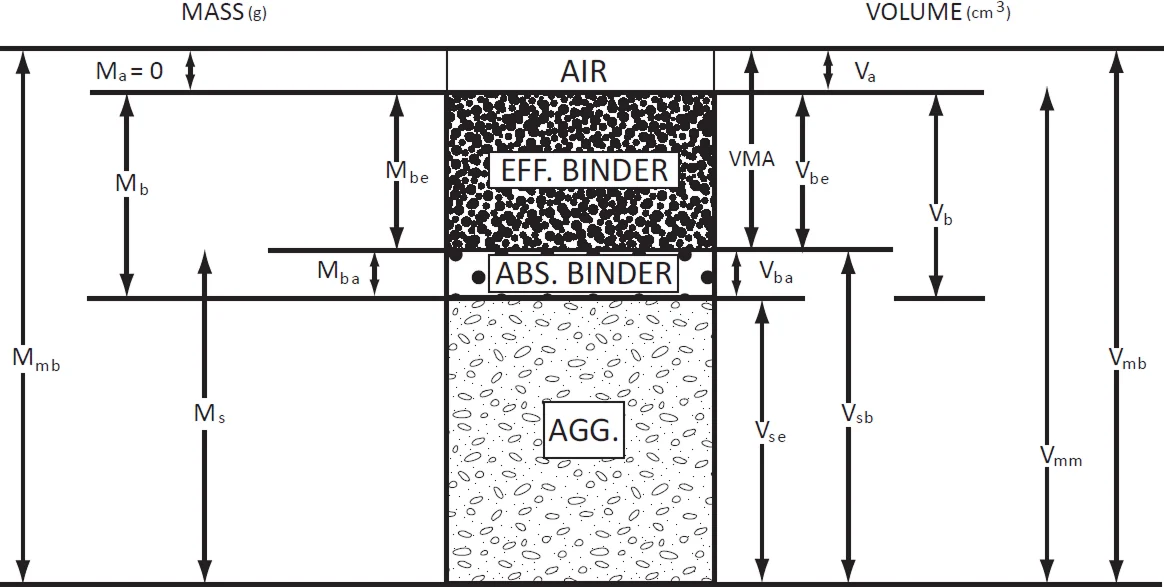
Source: Asphalt Institute
Figure 13. Asphalt Mixture Phase Diagram
A volumetric mix design is often followed by one or more performance tests to assess how the mix responds to certain stresses in controlled conditions. The following subsections briefly discuss commonly specified volumetric parameters.
3.4.1 Asphalt Binder Content
Since only the binder on the outside of the aggregate particles is useful in binding them together, that portion of the total binder content is called the effective binder content. The remaining portion of the total binder content is the percent absorbed binder. Note that the absorption capacity of aggregate is finite, so adding more binder over and above the absorption capacity of the aggregate will not increase the percent absorbed binder.
3.4.2 Percent Air Voids
Air voids in a compacted asphalt mixture consist of the small air spaces between coated aggregate particles.
Technicians often use the terms “percent density” and “percent air voids” when discussing the same mix characteristic. When percent is expressed as a percentage of theoretical maximum specific gravity, the relationship between the two is shown in the following equations:
Percent density = 100 − percent air voids, or
Percent air voids = 100 − percent density
It is important not to confuse laboratory-molded air voids with mat core air voids. Laboratory specimens are compacted at specified rates using calibrated machine-loading in steel molds that provide consistent confinement. Mat specimens are cut from a mat that was compacted by rollers of varying types and sizes using a non-prescribed number of passes and relies on the surrounding asphalt mixture and tack coat for confinement. Laboratory air voids provide information about the quality of the asphalt mixture. Mat core air voids provide information about the quality of the compactive effort on the mat.
3.4.3 Voids in the Mineral Aggregate
The term voids in the mineral aggregate (VMA) is defined as the intergranular void space between the aggregate particles in a compacted paving mixture, expressed as a percent of the total volume. VMA represents the space that is available to accommodate the effective volume of binder (i.e., the binder not absorbed into the aggregate) plus the volume of air voids in the mix.
An asphalt mixture needs a minimum percentage of VMA to have enough volume to hold both the proper amount of air voids and the proper amount of binder. If the VMA gets too low, the mixture does not have enough void space to hold the proper amounts of effective binder and air voids.
If the mix has enough air voids but not enough binder, the asphalt film thickness is too thin and the pavement becomes less durable. If the mix has enough binder but not enough air voids, the mix becomes less stable.
3.4.4 Voids Filled with Asphalt
Voids filled with asphalt (VFA) is the percentage by volume of the VMA that is filled with the effective binder. VFA, like VMA, tends to increase as the mix becomes finer and the total aggregate surface area grows.
VFA is calculated to ensure that the effective asphalt portion of the VMA in a mix is in the proper range. If the VFA is too low, the mix is too dry and will exhibit poor durability. If the VFA is too high, the mix is too rich and may be plastic and unstable.
The acceptable range of VFA varies depending on the loading situation of the mat. Higher loading requires a lower VFA, because mixture strength and stability are more of a concern. Lower loading situations call for a mix with a higher VFA to increase asphalt pavement durability.
3.4.5 Dust Proportion
The dust-to-binder ratio of a paving mixture, sometimes referred to as the dust proportion, is the ratio of the percentage of aggregate passing the 0.075-mm sieve to the effective binder. The dust proportion property is usually calculated for dense-graded mixes only.
In general, this property addresses the workability of asphalt mixtures. A low dust proportion often results in a tender mix, which lacks cohesion and is difficult to properly compact in the field because it tends to readily deform and move laterally under the roller. A high dust proportion can lead to durability issues because of an increased aggregate surface area.