
3. Asphalt Materials and Mix Design
3.7 Mix Design Procedures

Watch Video
To produce an asphalt mix design, asphalt binder and aggregate are blended together in different proportions in the laboratory. The resulting mixes are evaluated using a standard set of criteria to permit selection of an optimum binder content (OBC). The type and grading of the aggregate and the type and amount of the asphalt binder influence the physical properties of the mix. The design (or optimum) binder content is selected to ensure a balance between the long-term durability of the mix and its resistance to rutting (stability).
To produce an asphalt mix design, asphalt binder and aggregate are blended together in different proportions in the laboratory. The resulting mixes are evaluated using a standard set of criteria to permit selection of an optimum binder content (OBC).
3.7.1 Superpave Method
AASHTO M 323 Superpave Volumetric Mix Design and R 35 Superpave Volumetric Design for Asphalt Mixtures lay out the U.S. practices and specifications for the Superpave volumetric method of mix design. Many agencies supplement the volumetric method with additional testing to assess other properties such as the mix’s rut and cracking resistance. The Superpave gyratory compactor (see Figure 20) is used to compact asphalt mix specimens.
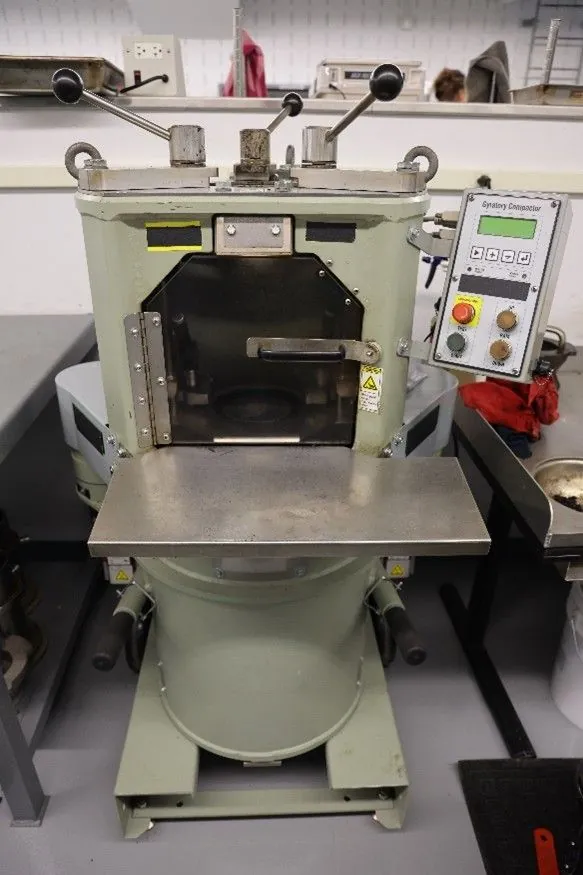
Source: National Asphalt Pavement Association
Figure 20. Superpave® Gyratory Compactor
The volumetric mix design is accomplished in four steps: 1) selection of component materials, 2) selection of design aggregate structure, 3) selection of design asphalt content, and 4) evaluation of moisture susceptibility. Selection of the component materials includes selection of the appropriate binder and aggregate that meet requisite quality characteristic parameters provided in the project specifications.
After component materials that meet quality requirements have been selected, the design aggregate structure must be selected. The broad band aggregate gradation is specified either by the mix NMAS in AASHTO M 323 or by gradation number in airfield specifications (the FAA P-401 and DoD UFGS 32 12 15.13).
The aggregate structure can simply be preselected if the designer has sufficient history/knowledge of the local materials. If the designer needs to select and evaluate aggregates from multiple sources or sources with which they lack sufficient familiarity, trial blends are normally designed and evaluated. The designer estimates the optimum asphalt content of each trial blend, then mixes and compacts specimens. The subsequent volumetric properties for each trial blend are evaluated to see if they meet specifications. Typically, the most cost-effective blend of aggregates that will meet both lab and field specifications is selected as the design aggregate structure.
Asphalt binder is then added to the design aggregate structure, typically anywhere from three to five binder contents at 0.5-percent intervals bracketing the estimated OBC. Typically, two identical specimens are prepared and averaged at each binder content so variability can be minimized. The OBC is typically selected as the binder content at a preselected air void content. For AASHTO M 323 specifications, the target air void content is 4 percent. FAA specifies 3.5 percent air voids. It is important to check local specifications for the target air void content. The volumetric properties at the OBC are determined, and the designer ensures that the asphalt mixture meets all volumetric specifications at that binder content.
The final step in the Superpave method is to determine the mixture’s moisture susceptibility. AASHTO M 323 specifically calls for AASHTO T 283, Resistance of Compacted Asphalt Mixtures to Moisture-Induced Damage, to pass with a tensile strength ratio of no less than 0.80. Other specifications may call for slightly different minimum tensile strength ratio values.
3.7.2 Marshall Method
The Marshall Method of mix design was historically the predominant method of mix design for dense-graded asphalt mixtures and is noted for the portability of its equipment. At the time of this writing, there is still one State DOT using the Marshall Method. It is an optional method for FAA and DoD mixtures, and it is still common outside the United States and Canada.
For a single selected aggregate gradation, specimens at five different asphalt contents are molded with manual or mechanical Marshall hammers and molds. FAA allows either hammer type in accordance with ASTM. DoD specifies the manual hammer or the mechanical hammer calibrated to the manual hammer. A given mass of asphalt mixture at a specified temperature is placed in the Marshall molds, and the hammer is used to deliver 35, 50, or 75 blows, depending on the specification. The mold is then flipped, and the same number of blows is delivered to the other side of the specimen. Typically, three identical specimens are prepared and averaged at each binder content so variability can be minimized.
The specimens are then tested for various volumetric criteria. In addition to mix volumetrics, the Marshall Method also applies mechanical testing in the form of stability and flow tests (AASHTO T 245, ASTM D6927), which are precursors to the Balanced Mix Design (BMD) tests that are now coming into common practice. The specimens are loaded in indirect tension using a compression tester. The stability value is basically the maximum load that can be supported by a compacted Marshall sample, and the flow value is the deformation corresponding to the maximum load. In most cases, the OBC should be selected for which the compacted specimen has 3.5 percent air voids (FAA) or 4.0 percent air voids while meeting Marshall stability and flow criteria.
3.7.3 Balanced Mix Design Method
Watch Video
Advancements in performance testing brought the concept of BMD to augment or even replace volumetric design. BMD, as defined in Transportation Research Board (TRB) Circular E-C280, Glossary of Terms for Balanced Design of Asphalt Mixtures is “an asphalt mixture design framework using mechanical tests correlated to field performance on appropriately conditioned specimens that address multiple modes of asphalt layer distress taking into consideration mixture aging, traffic, climate, and location within the pavement structure.” Although primary modes of distress considered by most practitioners of BMD are rutting and cracking, other distresses such as brittleness (evaluated by the Cantabro mass loss test) could also be considered in a BMD process. It is very important that any performance tests used are well-correlated to field performance.
Advancements in performance testing brought the concept of BMD to augment or even replace volumetric design.
As of this writing, the following are the four primary approaches to BMD for mixture design:
3.7.3.1 Approach D
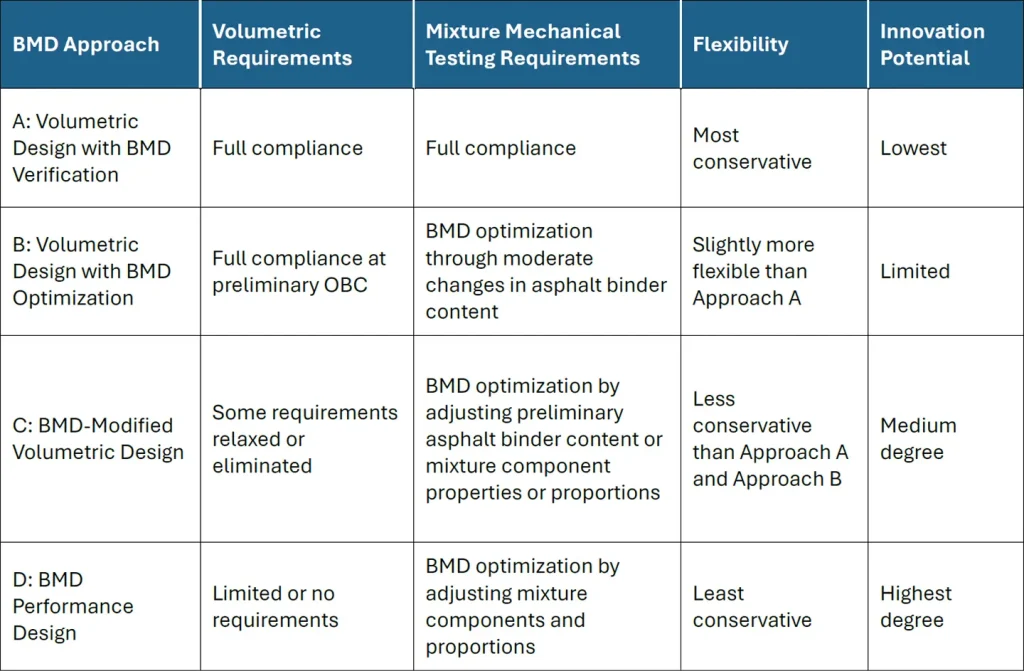
BMD Performance Design. This approach establishes and adjusts mixture components and proportions based on performance analysis with limited or no agency requirements for volumetric properties. The agency may set minimum requirements for asphalt binder quality and aggregate properties. Once the mechanical test results meet the BMD criteria, the mixture volumetric properties may be checked for use in production.
3.7.3.2 Approach C
BMD-Modified Volumetric Design. This approach begins with the volumetric mixture design method to establish preliminary component material properties, proportions, and asphalt binder content. The mechanical test results are then used to adjust either the preliminary asphalt binder content or the mixture component properties or proportions until the criteria are satisfied. For this approach, the final design is primarily focused on meeting BMD test criteria and may not have to meet all the mixture design volumetric criteria.
3.7.3.3 Approach B
Volumetric Design with BMD Optimization. This approach is an expanded version of Approach A. It also starts with the volumetric mixture design method for determining a preliminary OBC. Asphalt mixture mechanical tests are then conducted on the mix design at the preliminary OBC and two or more additional contents. The asphalt binder content that satisfies all the test criteria is identified as the final or target OBC. In cases where the BMD test criteria are not met at any of the binder contents, the entire mixture design process needs to be repeated using different mixture proportions or materials until all the BMD test criteria are satisfied.
3.7.3.4 Approach A
Volumetric Design with BMD Verification. This approach starts with the volumetric mixture design method for determining an OBC. The asphalt mixture at the OBC is then tested with the selected mechanical tests to assess its resistance to distresses of interest. If the mix design meets the test criteria, the JMF is established and production begins. If the mix design does not meet the test criteria, the entire mix design is repeated using different mixture proportions or materials until all the volumetric and BMD test criteria are satisfied.
A good reference for more details is NAPA publication IS-143 “Balanced Mix Design Resource Guide.” Table 3 summarizes each approach.
Table 3. Summary of BMD Approaches
3.7.4 RAP Considerations
The mix design should be specific regarding the source of the RAP and whether it has been fractionated or not. Some contractors fractionate RAP by passing it over one or more screens to produce separate coarse and fine stockpiles for a more controlled gradation. Fractionating RAP can reduce the overall variability of the final mix when using higher percentages of RAP. Fractionating also helps mix designers because the coarse and fine RAP stockpiles have different properties, increasing the ways that the RAP can influence volumetric properties. The fine fraction of the fractionated RAP will have a higher binder content while the coarse fraction will have a lower binder content, relative to the same RAP if it were not fractionated.
Some agencies limit the amount of RAP in the mixture by specifying a maximum allowable percentage by weight. This is an acceptable approach when the percentage of asphalt binder in the RAP is relatively similar to the total asphalt binder content of the mixture. With the increased use of fractionated RAP, many agencies now recognize the need to specify the amount of RAP in terms of the RAP binder ratio—the ratio of the RAP binder in the mix divided by the mixture’s total binder content. DoD and FAA airfield projects do not currently allow the use of RAP for surface mixes, except on shoulders.
Because the RAP binder has been significantly aged and stiffened, mixes with large percentages of RAP tend to be stiffer, less workable, and more difficult to compact during construction compared to mixes with a smaller percentage of RAP. If the impact of the aged RAP binder is not addressed in the mix design, the durability of a high RAP mix will suffer as well. High RAP mixtures should be engineered with a softer binder, more binder, or recycling additives to improve the durability of the mixture. The Asphalt Institute’s MS-2 offers detailed guidance on binder grade adjustments due to the use of RAP, but in summary:
- Asphalt binder content and gradation must be determined for all RAP levels.
- At lower RAP levels, (less than 15 percent), the stiffer RAP binder has minimal effect on the total mix binder stiffness, so no grade adjustment is necessary.
- At moderate RAP levels (between 15 and 25 percent), select one grade softer than normal (e.g., select a PG 58-28 if a PG 64-22 would normally be used in a virgin mix).
- At high RAP levels (greater than 25 percent), the physical properties of the extracted asphalt binder will need to be determined so that blending charts or equations can be used to select the appropriate grade of virgin binder. Assuming the RAP binder blends with the new binder at mixing temperatures, a softer new binder is blended with the stiffer RAP binder, resulting in a binder blend that meets the required grade for the project.
Once the appropriate virgin asphalt binder grade and percentage of each RAP source has been selected, the normal mixture design process can proceed.BMD testing can greatly assist in optimizing the mix design process using RAP. Refer to the NAPA BMD Resource Guide for more information.