
6. Mixture Delivery
6.3 TRUCK TYPES
Three primary types of trucks are used for asphalt paving jobs: the end-dump, the bottom-dump or belly-dump, and the live-bottom or flow-boy.
Regardless of the truck or trailer type, the floor of the hauling unit should be smooth and free of dimples that might cause release agents to puddle. The side walls of the box should also be true to prevent material hanging up during discharge. Overall, the truck bed should be clean, well-maintained, in good condition, and capable of safely and legally transporting material to the jobsite. The lifting device on dump beds should be maintained so that the bed can be lifted to continuously move the material from the truck bed to the paver hopper. All hauling units should be continually monitored for signs of mechanical problems or leaking fluids (except air conditioning condensate) that can potentially damage the asphalt. If problems are found, the hauling unit should be immediately removed from the lineup until repairs can be made.
6.3.1 End-Dump Trucks
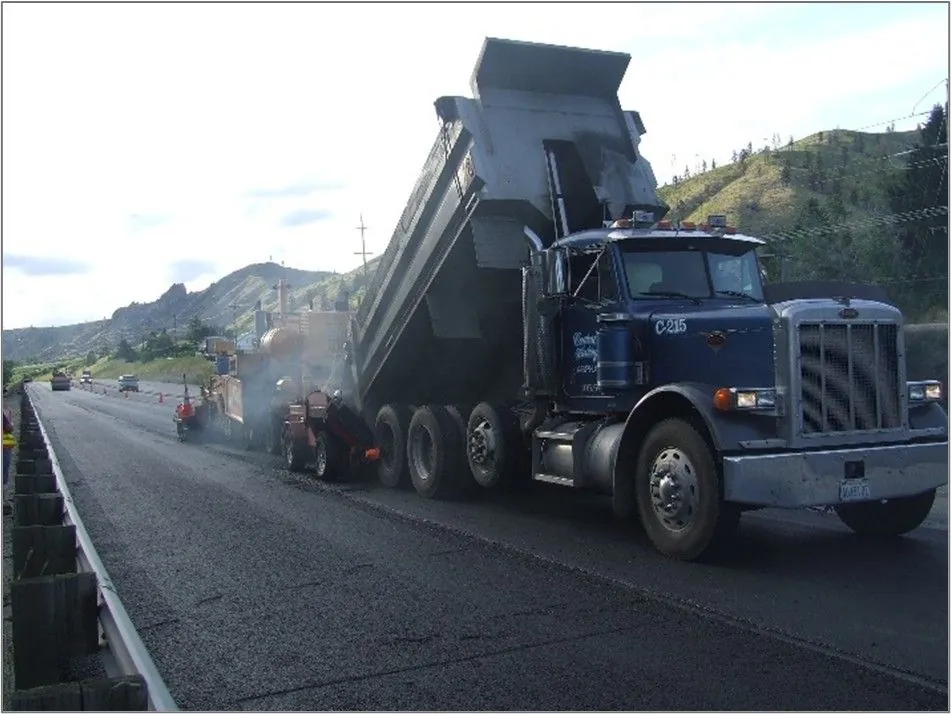
The end-dump truck delivers mix directly to the hopper of the paver or an MTV (see Figure 73). These trucks may have three to six axles and a capacity of 12 to 20 tons (11 to 18 tonnes). More axles mean more capacity. The advantage of the end-dump truck is its short wheelbase, which makes it easy to maneuver. The end-dump truck can also be a semitrailer truck, which is essentially a large, articulated dump truck, with a capacity of 20 to 25 tons (18 to 23 tonnes). The two disadvantages of this type of truck are that it requires improved operator skill and its large dump bed can cause problems with overhead obstructions (wires, bridges, and trees). Because of this truck’s size, special care should be exercised when loading it due to the increased potential for aggregate segregation. Especially for the larger end-dumps, care should be exercised to avoid having the truck bed pressing against the paver. This is most likely to happen when the bed is at its highest point
Source: Asphalt Institute
Figure 73. End-Dump Truck
6.3.2 Bottom-Dump Trucks
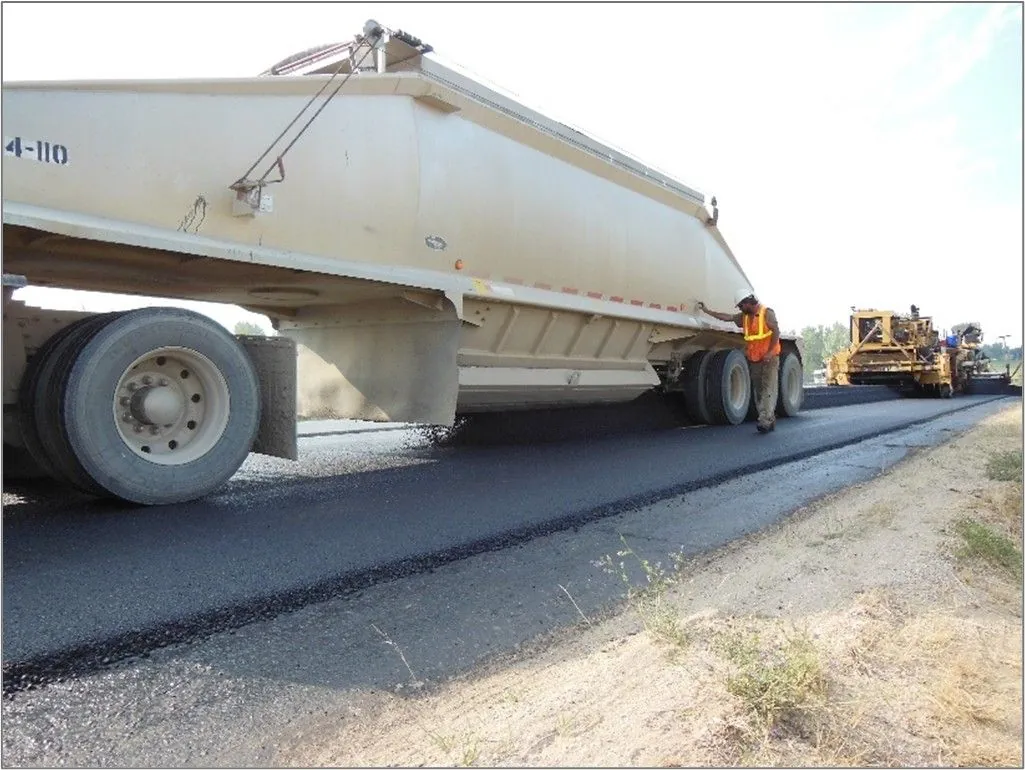
Bottom-dump trailers (often referred to as belly-dump trucks) are used when windrow paving is utilized (see Figure 74). Windrow paving is a process where asphalt mixture is placed directly on the roadway in front of the paver, which is equipped with a pickup machine (also known as a windrow elevator) that collects the windrowed material and feeds it into the paver hopper. This windrow elevator may be a standalone unit or may be connected directly to the paver.
Bottom or belly-dump trucks generally require that a dump operator be stationed on the grade to open the gates and control the spread rate of the asphalt material onto the grade in front of the paver. The dump operator is responsible for maintaining the proper amount of material to keep the paver hopper uniformly charged. The windrow should be consistently sized from truck to truck. During paving, if the quantity on the grade is found to not match the paving width or depth, material should be added or removed—without stopping the paver. The dump operator needs to be trained to also monitor the depth of material in the hopper to ensure that a proper volume of material is being supplied. They should adjust the discharge volume if necessary to properly balance the needs of the paving project.
Source: Asphalt Institute
Figure 74. Bottom-Dump Truck
6.3.3 Live-Bottom Trucks
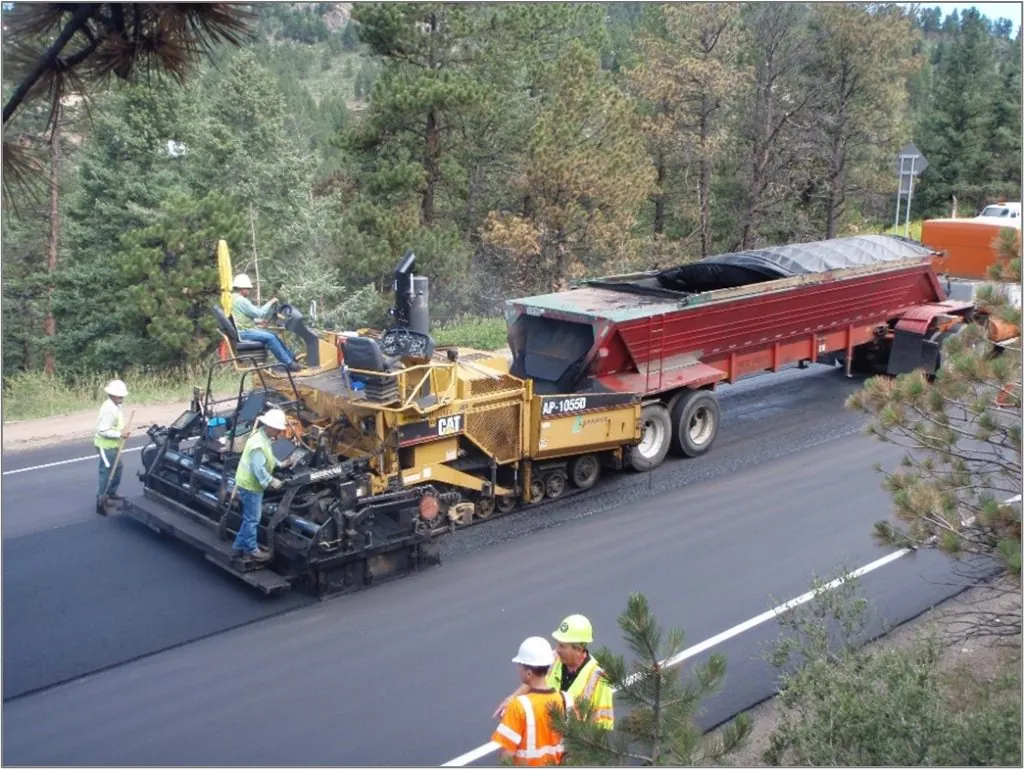
Live-bottom trucks (also known as flow-boy or horizontal-discharge trucks) have a conveyor system that moves the material from the hauling unit directly into the paver hopper without the need to raise the truck bed (see Figure 75). This system has a safety advantage because the bed does not need to be raised, so it is not prone to interacting with overhead hazards such as utility lines. Segregation is minimized as the material is moved in mass on the conveyor system or live-bottom system as it is discharged into the paver hopper. Moreover, this style of truck does not press on the paver hopper as can happen with end-dumps.
Proper cleaning of the conveyor or discharge plates ensures that cold chunks are not left in the truck bed. Daily checks between loads ensure that the system is operational and that no loose or damaged components will break during the workday.
Source: Asphalt Institute
Figure 75. Live-Bottom Truck