
6. Mixture Delivery
6.5 Hauling Procedures
After the haul vehicles are loaded at the plant, they must proceed directly to the paving location. It is important that truck drivers be thoroughly trained so they are aware of what is expected during loading, hauling, and unloading to maintain a steady flow of asphalt mixture to the paver. Haul trucks should not arrive simultaneously with other haul trucks (clustering or platooning). A notable exception is military airfield paving work, where platooned-deliveries may be required for ingress and egress from the facility being paved for security reasons. Driver training should focus on safe and timely deliveries as key elements in the construction of a quality asphalt pavement.
All haul truck beds should be smooth and clean. Truck beds should be inspected for cleanliness prior to loading them with fresh mix. The bed of the haul truck should be free of all deleterious materials before the mix is placed in it. Any debris in the bed from previous use of the truck should be removed. The bed should also be reasonably smooth and free of any major indentations or depressions where the truck bed release agent and mix could accumulate. The dumping lip should be cleaned between loads, and tailgate-latching devices should be lubricated so they release on command.
6.5.1 Release Agents
Once the haul truck bed is clean, it should be coated with a release agent to prevent the asphalt mixture from sticking to the bed. Nonpetroleum-based materials should be used for this purpose. While diesel fuel was once the most used release agent, it is no longer allowed and should not be used as it damages the mixture. Modern release agents are proprietary chemical packages that are supplied in concentrated form and diluted with water to application strength. Most agencies will have an “approved products list” for release agents. Manufacturers’ dilution and application rates must be observed to ensure good performance.
The release agent should be sprayed uniformly over the sides and bottom of the truck bed, using the minimum quantity necessary to cover the surface area of the bed without runoff. Any excess agent should be drained from the bed before the truck is loaded with mix. It is important to monitor the effectiveness of the release agent with the type of binder and mix being used. If trucks require excessive cleaning after each delivery, a different release agent may be appropriate.
6.5.2 Tarps and Insulated Beds
Maintaining the temperature of the plant mix during its journey from the plant to the paving site is imperative. If mixture temperature differentials of 25 °F (14 °C) or more occur, the mixture is considered thermally segregated. Cooler days and/or longer hauls increase the probability of this occurring. Ideally, all trucks should have insulated beds and an insulating waterproof cover (also known as a tarp) that overlaps both the sides and back of the bed to keep airflow and rainwater off the asphalt mixture (see Figure 77). The overlap should be at least 1 ft (0.3 m). The insulation should be both on the sides and the bottoms of the beds. These features assist in combating thermal segregation. Some agencies require the use of tarps regardless of weather conditions.
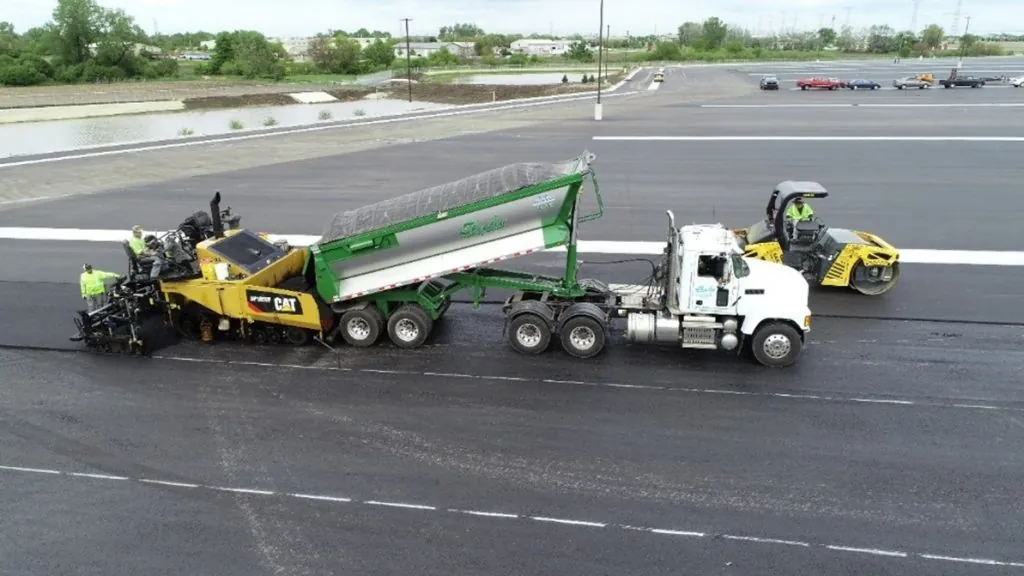
Source: Tim Murphy
Figure 77. Tarped Truck Bed
6.5.3 Truck Spacing
The goal of trucking is to provide a steady, regularly spaced, uninterrupted supply of consistent, homogeneous material. A factor in accomplishing this is to determine the ideal spacing between trucks. This ideal spacing can be determined based on the inputs for calculating the minimum truck numbers (see Section 6.2). Namely, the total cycle time divided by the actual number of haul trucks used should indicate appropriate truck spacing. Admittedly, a lot of external factors that are beyond the control of the contractor can come into play once a truck is on the road and alter this gap in real time.
The goal of trucking is to provide a steady, regularly spaced, uninterrupted supply of consistent, homogeneous material.
Maintaining the calculated interval and avoiding clusters of trucks at the asphalt plant at the paver can be a significant challenge. This is especially true on urban paving projects. Training is the key. Namely, training the truck drivers, plant operator, dump person, and paver operator on why this uniformity is desired and what to do when it is violated. When trucks return to the plant in a group, the plant operator should be trained to maintain the proper loading interval to reestablish the correct truck spacing. Similarly, when a group of trucks arrives at the paving site, the dump person and the paver operator should maintain their pace to reestablish the proper interval as well. Consistency builds a better road and airfield pavement.