
6. Mixture Delivery
6.6 Unloading the Mix
When the loaded haul trucks arrive at the paving location, the next step is to unload the trucks by transferring the asphalt mixture to the paver. The use of best practices to transfer the load of asphalt mixture from the haul truck to the paver is necessary to ensure that paver operation is continuous and that the mix is not segregated during the unloading process.
The onsite individual designated as the dump person controls the unloading of the trucks and has a major influence on both the smoothness of the mat and the potential for segregation. The paver operator must concentrate on the laydown process and is not available to address communication problems directly to a driver without stopping the paver. For this reason, a trained dump person is recommended.
The unloading procedure will naturally vary depending on the type of truck being unloaded. Thus, the following sections address unloading directly into the paver’s hopper, windrow paving, and the use of an MTV.
6.6.1 Direct Feed into the Paver
If an end-dump truck is used, the bed of the truck should be raised a short distance to break the load to the rear and allow the mix in the bed to shift and slide back against the tailgate before it is opened. This practice will cause any segregated coarse aggregate material to be incorporated back into the mass of mix rather than being delivered first into the paver hopper. Once the tailgate is opened, this procedure will also allow the mix to be discharged from the truck in a mass and to flood the hopper of the paver, further reducing the possibility of segregation behind the paver screed. In addition, raising the bed before the truck backs into the paver reduces the time required to unload the truck and makes the truck exchange more efficient. The use of tailgate chains to control the tailgate opening to reduce mix flow is seriously discouraged. Reducing the mix flow to a slow-moving stream could result in a major source of segregation.
The same procedure should be employed, if possible, when a live-bottom truck is used to transport the mix. On some such trucks, it may be possible to start the belt or slat conveyor for a few seconds before the end gate on the truck is opened. Doing so will create a mass of material that can be delivered to the hopper, instead of allowing any coarse aggregate particles that have rolled to the end gate to exit into the hopper first.
For both end-dump and live-bottom trucks, it is imperative that the trucks do not back all the way to the paver, bumping against it. Bumping the paver will create an indentation or bump in the mat that rolling cannot remove. Rather, these trucks should back to within 12–18 inches (300–450 mm) of the paver, as directed by the dump person or paver operator. At this point, the truck stops, releases the brakes, and waits for the paver to make contact.
For both end-dump and live-bottom trucks, it is imperative that the trucks do not back all the way to the paver, bumping against it. Bumping the paver will create an indentation or bump in the mat that rolling cannot remove.
After the paver contacts the hauling unit, push rollers mounted on the front of the paver facilitate moving the truck forward without interfering with the rotation of the truck tires. If a wheel-locking device is being used, it locks the hauling unit to the paver to prevent separation and spillage on the grade and simplifies the operation on rolling terrain. Once the wheel-locking device is engaged, the driver should be instructed to raise the dump bed and release the tailgate as quickly as possible to surge the paver hopper.
When a wheel-locking device is not used, the experienced truck driver will anticipate the sudden rush of material into the paver hopper and briefly apply additional brake pressure to prevent the hauling unit from being forced out from the hopper and spilling material onto the pavement directly ahead of the paver. Without a wheel-locking device, it may be necessary for the driver to continually maintain a slight pressure on the brakes to keep the truck from rolling away from the paver as the load is emptying. This is especially true when paving steep grades. Additional training for truck drivers is encouraged to minimize issues.
6.6.2 Windrow Paving
Windrow paving places the mix in a longitudinal windrow on the grade directly in front of the paver to facilitate a nonstop paving operation. A pickup machine operated in front of the paver picks up the material and places it in the hopper. Windrow paving operations are usually confined to warm, dry climates, where the chance of a surprise rainstorm cooling the material in the exposed windrow is minimal.
The dump operator plays a vital role in maintaining a quality paving operation. Proper windrow management will maintain continuous paving speed while minimizing segregation and heat loss. The quantity of mix on the grade is controlled by a dump operator as the hauling unit is unloaded and the size of the windrow is adjusted according to the level of material in the hopper. A well-trained crew can successfully pave for hours, producing a high-quality mix pavement without stopping.
The windrow-building process can allow the mixture to segregate, with the larger aggregate accumulating along the bottom outside edges of the windrow. Therefore, steps must be taken to ensure that the windrow pickup device picks up the entire windrow cleanly and that any segregated material is directed back toward the center of the material flow as it is moved through the windrow pickup device and into the paver. Adding plates to force the material into a smaller stream and keeping the volume of material in the hopper at a high level helps reduce mix segregation.
A uniform unloading process calibrated to the plant production and paver speed will assist in maintaining proper truck spacing and continuous paving. Once a windrow is started, each successive truck should back over and straddle the full cross-section end of the previously placed material to eliminate load-to-load segregation and maintain uniform windrow size. No more than one load of mix should be allowed to be exposed at any time.
6.6.3 Material Transfer Vehicle
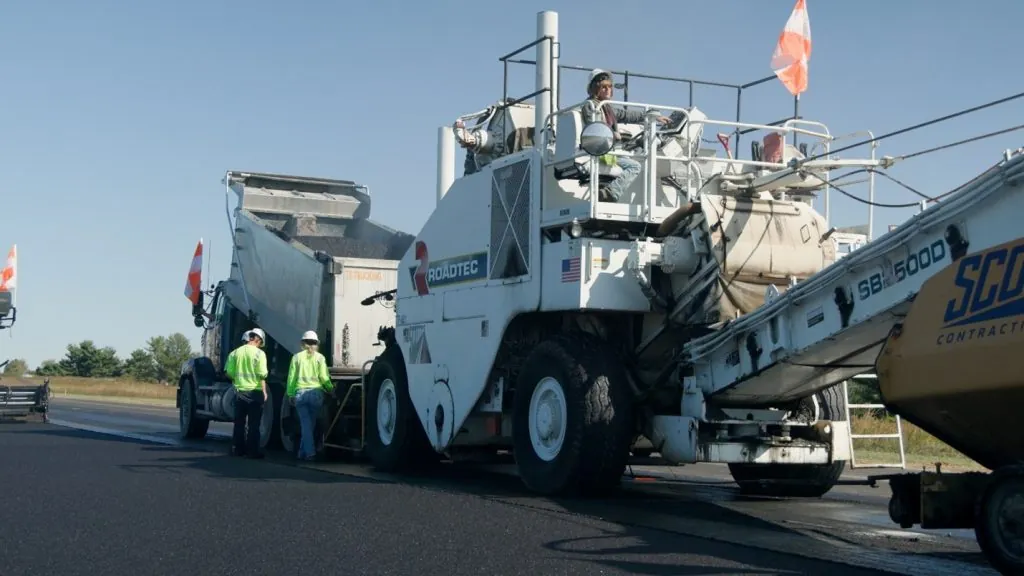
The MTV (see Figure 78) is primarily used to transfer the material from the haul truck to the paver hopper. The use of an MTV has several benefits but adds additional cost to the paving operation. An MTV has been shown to improve smoothness and reduce segregation. For these reasons they are specified to be used on airfields and are required on many highway projects.
When used properly, an MTV makes it easier to have a nonstop paving operation. The material holding bin or belt on an MTV acts as a surge hopper and can hold up to 25 tons (23 tonnes) of mix. A special insert in the paver hopper holds an additional 15 tons (14 tonnes). With the equivalent of two to three extra truckloads of material immediately in front of the paver, this onsite material storage is valuable because it allows for continuous paving even when there is a delay in truck deliveries from the plant.
Source: National Asphalt Pavement Association
Figure 78. Material Transfer Vehicle
When an MTV runs out of material, the paver must stop, and a continuous paving operation is not possible. Keeping a constant stream of trucks in front of the MTV is therefore necessary if a continuous paving operation is to be achieved. If a gap occurs, the MTV should be stopped without being completely emptied when waiting for trucks so that a consistent minimum amount of mix is retained on the augers to mix with the new material delivered from the next haul truck. In addition, the paver should be stopped with its hopper half full so that the amount of mix in front of the paver screed remains constant and the proper smoothness of the mat is achieved.
Loading materials into an MTV is like loading into a paver. Direct feed with an end-dump or live-bottom truck or a windrow operation can be employed.
Offsetting an MTV from the lane being paved can have noted advantages too. Namely, this practice can keep all the construction vehicles out of the paving lane. This protects the tack coat from contamination or tracking, improving its performance. Operating an MTV in this manner is generally required on airfield paving projects.
The mass of an MTV is quite large. Therefore, an assessment of the existing material’s ability to handle this loading without being damaged is important. Especially on low-volume roadways, caution is advised.