
8. Compaction
8.6 Determination of Rolling Pattern

Watch Video
The roller pattern is the number of passes and coverages that the respective rollers are seeking in each of the phases of densification. It is a notable challenge for a roller operator to maintain the pattern throughout a paving operation. Use of advanced technology such as IC has been shown to greatly assist this task.
8.6.1 Calculation of Rolling Pattern
The number and type of rollers needed on a project can vary. Regardless of the number of rollers, the basic sequence of rolling for a typical project can be broken down into the following three phases. Preferably, there is at least one roller for each of these phases.
- Breakdown (initial) rolling—the first sequence of passes performed by the roller(s) designated for breakdown on the freshly placed mat.
- Intermediate rolling—all subsequent passes by the roller(s) to obtain the required density before the mixture cools to the cessation temperature.
- Finish rolling—rolling done solely for the improvement of the surface appearance while the mixture is still warm enough to permit removal of any roller marks. Generally, increased density is not expected because of finish rolling.
A consistent roller pattern must be followed to ensure a mat of specified density, shape, and smoothness. The roller pattern dictates which parts of the mat are rolled first and which part is rolled last. Roller patterns will depend on many factors, including paving width, roller width, required number of passes to obtain specification density, and the specifics of the longitudinal joints (confined versus unconfined), as described in the next chapter.
As project conditions change, the contractor must be willing to modify the compaction operation to ensure that target density is obtained. Test strips are intended to evaluate the entire paving operation, from production through compaction. This allows the contractor to demonstrate their ability to meet specifications before going into full production.
8.6.1.1 Breakdown Rolling
The purpose of breakdown rolling is to achieve a high percentage of the target density while the mat is at its highest temperature. This is accomplished by using breakdown rollers with the highest compactive forces that are appropriate for the asphalt mixture type and lift thickness being used on the project.
It is important to start the breakdown rolling operation on the low side of the mat (usually the outside of the lane being paved) and progress toward the high side. The reason is that hot mixtures tend to migrate toward the low side of the mat during compaction. If rolling is started on the high side, migration is much more pronounced than if rolling starts from the low side.
When the asphalt mixture is relatively easy to compact, a single breakdown roller may be sufficient. In scenarios where high production rates dictate high paver speed or where the mix is difficult to compact, two or more breakdown rollers are often used. Figure 122 shows two vibratory rollers working together to speed up the compaction process and increase compactive effort while the mat is at optimum temperature.
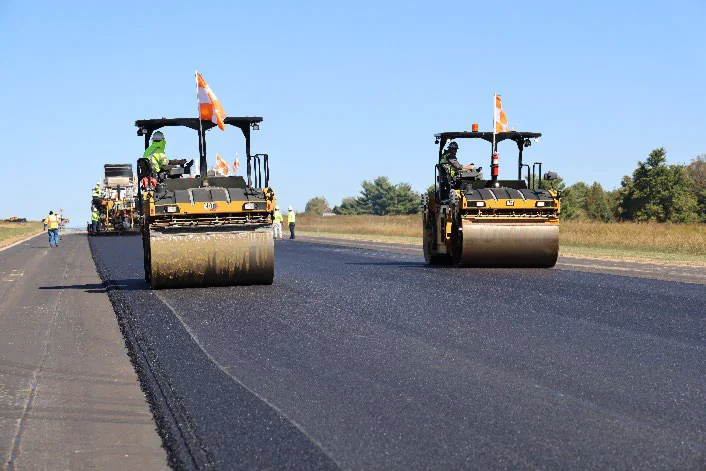
Source: National Asphalt Pavement Association
Figure 122. Breakdown Rolling with Multiple Vibratory Rollers
8.6.1.2 Intermediate Rolling
Intermediate rolling should follow breakdown rolling as closely as possible while the asphalt mixture is still well above the cessation temperature. Intermediate rolling should be continuous until all the mix has been thoroughly compacted. Multiple rollers working together can also be used for intermediate compaction, especially on high-production projects where paver speeds are high. Occasionally this phase can be omitted if the breakdown rolling has achieved the needed density.
8.6.1.3 Finish Rolling
Finish rolling is the final phase in the compaction process, done solely to remove roller marks left by breakdown and intermediate rollers so the surface looks good and rides smoothly. Therefore, finish rolling is done at relatively low temperatures, and while the material is still warm enough for removal of roller marks. Vibratory rollers must be operated in static mode when used for finish rolling because the vibrations can damage the cool mat.
8.6.1.4 Compaction of Stiff Mixes
Asphalt mixtures that are properly designed will be reasonably stiff and stable and will require a considerable amount of compactive effort to attain the required degree of density. This type of mix will support the weight of the compaction equipment directly behind the paver. If the mix is placed at a temperature of 275 °F (135 °C) or higher, the rollers will typically be able to compact the mix properly before it cools to a cessation temperature.
Most often, three rollers are used: a breakdown roller, an intermediate roller, and a finish roller. For breakdown rolling, as discussed above, a vibratory steel-drum roller is most often used. For intermediate rolling, a pneumatic tire roller is generally employed, although sometimes a second vibratory or an oscillatory roller is used. Finish rolling is normally done with a static steel-wheel roller or a vibratory steel-drum roller used in static mode.
The breakdown and intermediate rollers should stay close to the paver. If the mix is stable, a bow wave will not occur in front of the vibratory roller drum, and the mix will not exhibit any cracking or checking. With a relatively stiff mix, the finish roller may also be close to the paver since there will be minimal marks from the breakdown and intermediate rollers to be removed.
Because of the internal stability and strength of a stiff mix, more compactive effort may be needed to obtain a given level of density (percent of TMD), but the mix will not creep outward under the compaction equipment during the rolling process. Stiff mixtures of this sort are most commonly found on airfield projects.
For very stiff mixes or when a high degree of density is desired, a pneumatic tire roller may be used for breakdown rolling. For intermediate rolling, a vibratory steel-wheel roller should follow directly behind the pneumatic tire roller, and the finish rolling should be done with a static steel-wheel roller.
8.6.2 Compaction of Tender Mixes
A tender mix is internally unstable, tending to displace laterally and shove while being compacted. Internal mix stability is a function of asphalt binder viscosity, mat temperature, and aggregate gradation and shape. Temperature-induced tenderness is usually one of two types: high-temperature tenderness or midrange temperature tenderness.
8.6.2.1 High-Temperature Tenderness
At high temperatures, some mixes may not be stable enough to support roller loads without laterally displacing. Since this occurs at high temperatures, it is most often encountered by the breakdown rollers when near the paver. Mats exhibiting high-temperature tenderness are typically compacted by merely waiting for the mat to cool to where the asphalt viscosity is high enough to support roller loads. Usually this is enough to solve the problem, but in rare instances the wait period may be so long that the mix cannot be adequately compacted before reaching cessation temperature. Oscillatory rollers have been shown to offer increases in density at lower temperatures than vibratory rollers. If no combination of rollers can successfully achieve density, a new mix design may be warranted. Mixes that exhibit high-temperature tenderness are often susceptible to rutting later in life.
8.6.2.2 Midrange Temperature Tenderness
Some mixes are stable at high temperatures but are unable to support roller loads without laterally displacing at midrange temperatures (typically between 240 °F [115 °C] and 190 °F [90 °C]). The “tender zone” is a term generally associated with this midrange temperature tenderness. There are several theories on the mechanism causing the tender zone, but arguably the most common is that when the mixture is placed, its temperature is relatively hot and uniform throughout. During compaction, the top and bottom layers of the mat cool more rapidly. The middle layer remains hotter and thus is less stiff than the top and bottom of the mat. When rolled in this condition, a steel-wheeled roller tends to push the top portion of the mat laterally past the bottom portion of the mat using the middle portion as a lubricating layer. Additionally, the mix is still fluid enough in the middle portion of the mat to cause the drum to sink into the mat and create a small wave in front.
Several different techniques can be used to compact a mat exhibiting midrange temperature tenderness. First, if done quickly and efficiently, breakdown rolling can be completed before the mat reaches the tender zone. A pneumatic tire roller can then be used during the intermediate phase. Finally, a static steel roller can be used for finish rolling if it is kept off the mat until its temperature has dropped below the tender zone.
8.6.2.3 Causes of Tender Mixes
Tender mixes can also be caused by any one or a combination of these additional factors:
- Excessive moisture content—Excess moisture can come from inadequately dried aggregate or, in the case of an overlay, moisture on or in the existing pavement surface. This moisture decreases the internal mix strength by increasing the liquid content of the mix. As the moisture is converted to steam, it effectively foams the hot liquid asphalt, causing it to expand and push the aggregate particles apart.
- Excess asphalt binder content—At paving temperatures, asphalt binders act as a lubricant during compaction. Mixes with high asphalt content will compact easily but may shove under roller loads.
- Rounded aggregate particles—Rounded particles, found in sands and gravels, tend to slip by one another during compaction, causing distortion and shoving during rolling.
- Excess midsize fine aggregate (between the 0.60 and 0.30-mm [No. 30 and No. 50] sieves)—This can be a result of excessive amounts of natural sands incorporated in the mix design or during mix production.
- Insufficient fines (aggregate passing the 0.075-mm [No. 200] sieve)—During production, dust and extremely fine aggregates become mixed with the asphalt binder and provide a certain amount of stiffness.
- Poor bonding to the existing pavement (for overlays)—If an overlay is poorly bonded to the existing surface, it may act tender as it displaces laterally rather than compacts under rollers. A poor bond can result from not using sufficient tack coat or best practices to apply it.
- Excessive mix temperature—At excessively high temperatures, the asphalt binder may not be viscous enough to support compaction. In some cases, the surface has cooled, but the center of the mix can still be too hot to support rollers. Mixes should generally be placed at an appropriate compaction temperature so rolling can begin immediately behind the paver.
- Compaction techniques—Poor compaction techniques can exacerbate tenderness problems. Quick stops and starts with a steel-wheeled roller will create excessive forces that promote lateral displacement. Operating a vibratory roller in the static mode during breakdown rolling and eliminating quick starts/stops will decrease the potential for lateral mix movement. Generally, mixes that appear tender under a steel-wheel roller will appear less tender under a pneumatic tire roller; therefore, use of a pneumatic roller for breakdown compaction should be considered.