
9. Joint Construction
9.4 Echelon Paving and Rolling

Watch Video
Because LJs are often susceptible to early deterioration, it is wise to reduce the number of LJs on a project where possible. If project staging and traffic control allow paving multiple lanes or shoulders in a single pass with screed extensions, at least one joint can be eliminated. Section 7.3 covered screeds and screed extensions, including photos.
Another excellent option to reduce the number of LJs is to utilize echelon paving if project staging, logistics, and traffic control allow. In echelon paving, adjacent lanes are placed and compacted side by side at the same time with multiple paving trains. The LJ created between these paving trains is called a hot joint because both sides are hot when placed and compacted. Experience has found that hot joints from echelon paving have better long-term performance compared to cold joints.
Experience has found that hot joints from echelon paving have better long-term performance compared to cold joints.
Echelon paving is not common on roadway projects because there is typically a need to maintain traffic flow, so closing multiple lanes is difficult. Airfields, large commercial parking lots, and new highway construction are examples where echelon paving should be considered (see Figure 146).
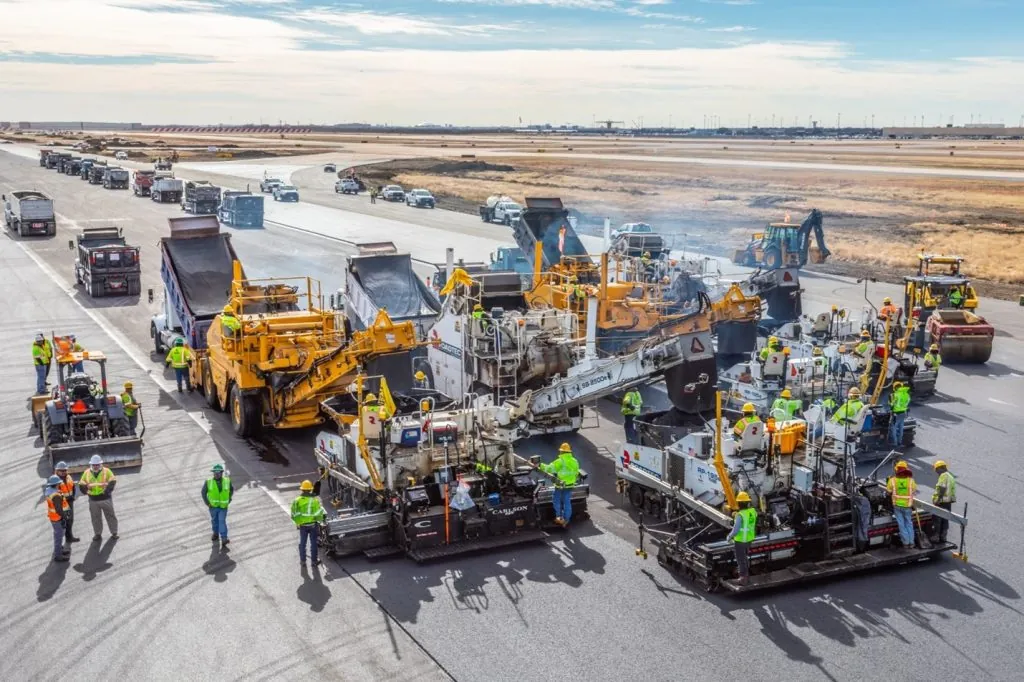
Source: Dallas Fort Worth International Airport
Figure 146. Echelon Paving with Four Paving Trains on a Runway at DFW Airport
The limiting factor on the number of paving trains utilized with echelon paving is often the overall mix production to feed the pavers. Utilizing two paving trains is the most common occurrence with echelon paving, while utilizing four paving trains, as seen in Figure 146, is extremely rare.
Lanes are placed simultaneously with the pavers separated by only a short distance, usually less than 100 ft (30 m). This short distance allows the mats to effectively be welded together by the compaction train before the mix on either side of the joint cools. Overlap is typically targeted at 1 inch (25 mm).
Having a standard rolling train behind each paver is recommended. To maximize density at the hot joint, the breakdown roller following the lead paver should leave approximately 4 to 6 inches (100 to 150 mm) of the common edge or joint unrolled. This common joint is then compacted by the first pass of the breakdown roller following the second paver. To accomplish this effectively, the second paver must keep as close as possible to the first paver to minimize any temperature difference between each side of the joint. The material on each side becomes a single mass under the roller, and there is little or no difference in density between the two lanes.