
9. Joint Construction
9.5 Unconventional Longitudinal Joint Methods
This chapter has already discussed many LJ techniques, options, and products that may not be considered “conventional.” They include the following:
- Always having confinement when placing and rolling the LJ (Sections 9.3.3 and 9.3.4). This can be achieved by milling and then paving one lane at a time versus milling multiple lanes.
- Paving wider and echelon paving (Section 9.4).
- Milling or cutting back the joint (Section 9.3.1.4).
- Rubberized joint adhesives applied to the face of the joint (Section 9.3.3.1).
- Utilizing rubber-tire (pneumatic) rollers when compacting the hot side of the joint (Sections 9.3.4 and 8.3.2).
There are three other unconventional techniques not yet mentioned: joint heaters, surface sealers, and void-reducing asphalt membrane (VRAM). All three were developed with the intent of improving LJ performance. They are not being endorsed by the authors or sponsors of this Handbook but rather are mentioned to be inclusive of other unconventional techniques not already mentioned here.
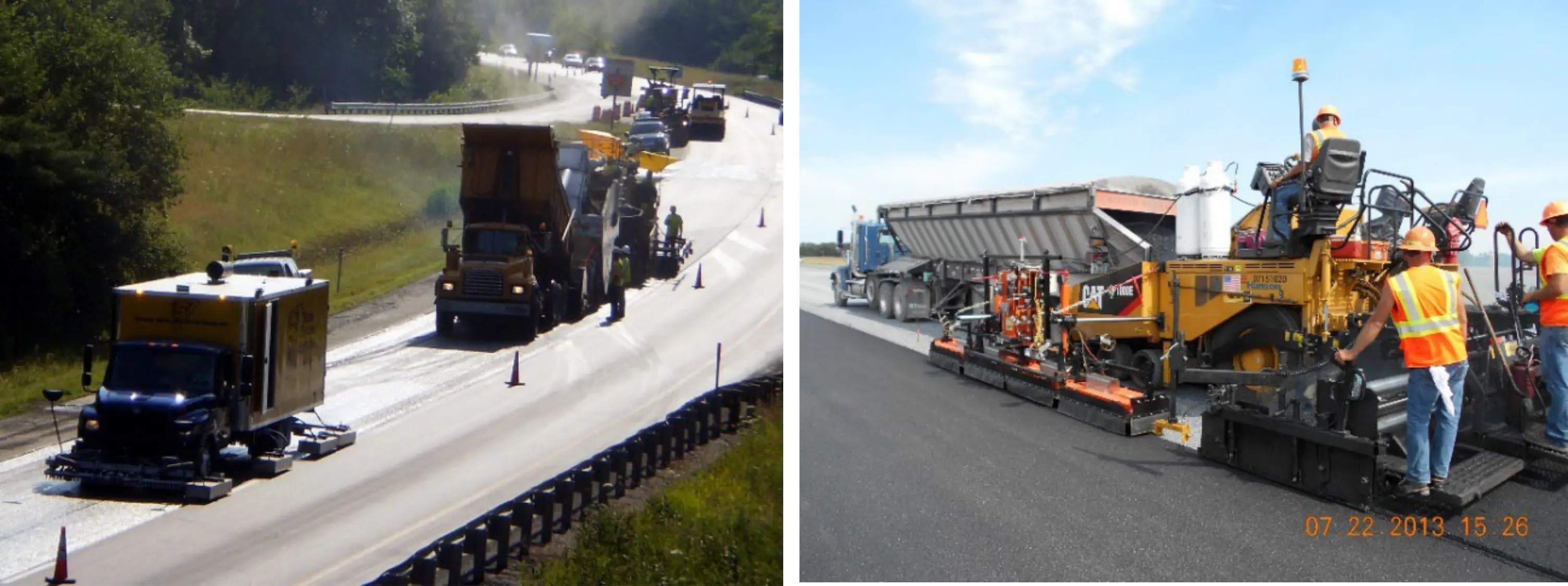
Joint heaters—The use of infrared joint heaters to heat the face of the cold joint just prior to placing the confined side. These heaters are used most frequently in cold climates and cold-weather paving. Some recent studies have shown heaters can improve joint density by 1 to 2 percent. Care must be taken to not overheat the joint and cause damage to the binder. Heater technology has improved to include longer and more efficient infrared heaters and automation with paver speed to minimize overheating or underheating the joint. Figure 147 shows the two general types of joint heaters: those that are self-contained units operating in front of the paver and those mounted on the paver itself.
Source: Asphalt Institute
Figure 147. Joint Heaters: Self-Contained (left) and Paver-Mounted (right)
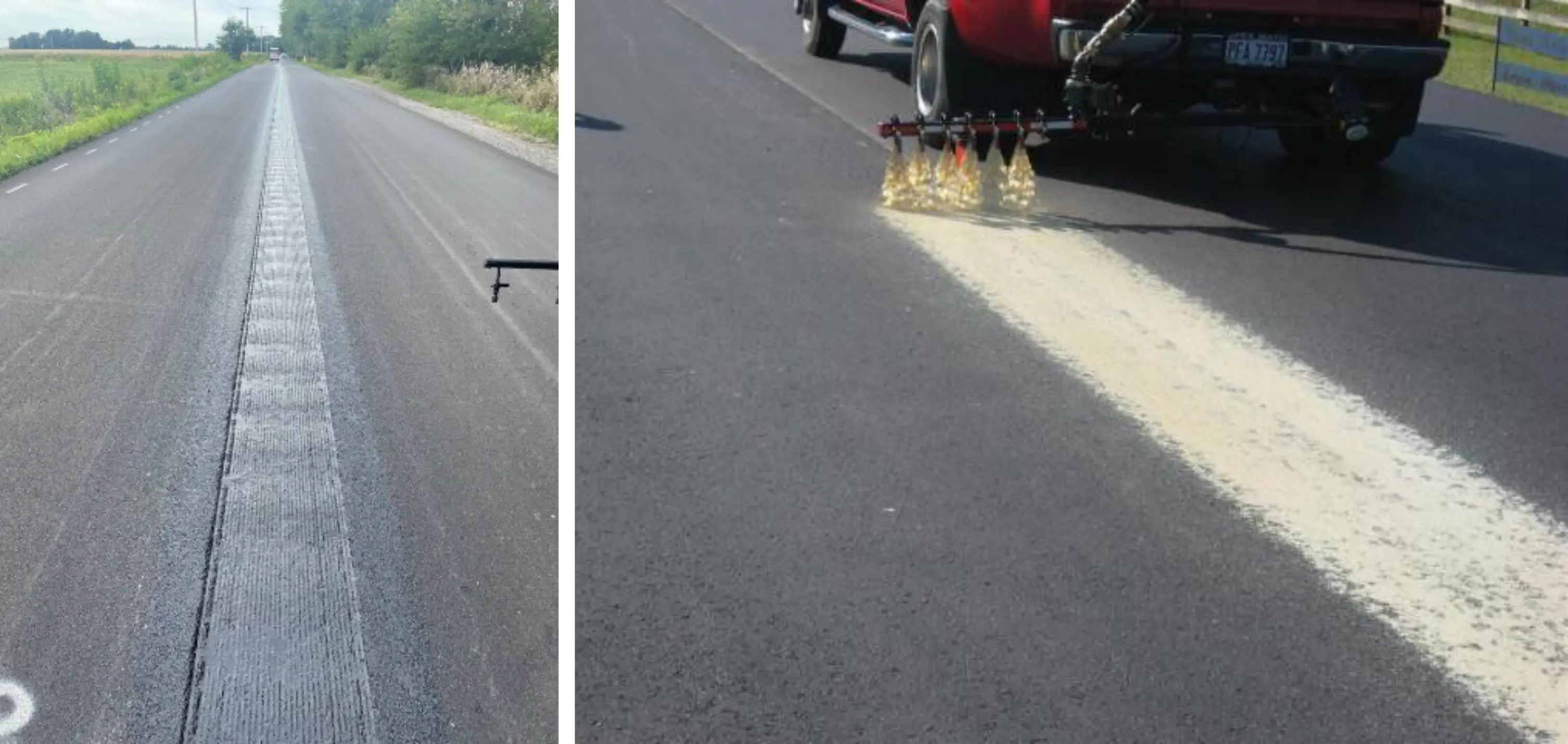
Surface sealer and rejuvenator products—These are sprayed on top of the completed joint with a typical width of 1 to 2 ft. These topical treatments are applied either when the joint is new or after the joint has been in service for some time. Some States use them as a remedial action for not meeting a minimum density at the joint. These products seal the joint from the top down to reduce absorption and permeability. They are also referred to as a joint stabilizer or joint enrichment. Another type of joint sealer product is called rapid penetrating emulsion (RPE), which is an asphalt emulsion containing about 30 to 40 percent asphalt binder designed to penetrate voids in the asphalt pavement. The penetrating nature of the RPE is important because it carries the asphalt residue into the voids and reduces air and water intrusion while maintaining pavement texture. Figure 148 shows an application of RPE and an application of a rejuvenator that dries clear. Restriping is necessary with RPE and other asphalt-based surface sealers such as fog seals or microsurfacing, but it is not necessary with many of the rejuvenator products that dry clear. These surface sealers are often used over centerline rumble strips. Like all these unconventional techniques, more research is needed on long-term benefits.
Source: Asphalt Materials, Inc.
Figure 148. Surface Sealers on LJs: RPE (left) and Rejuvenator VRAM (right)
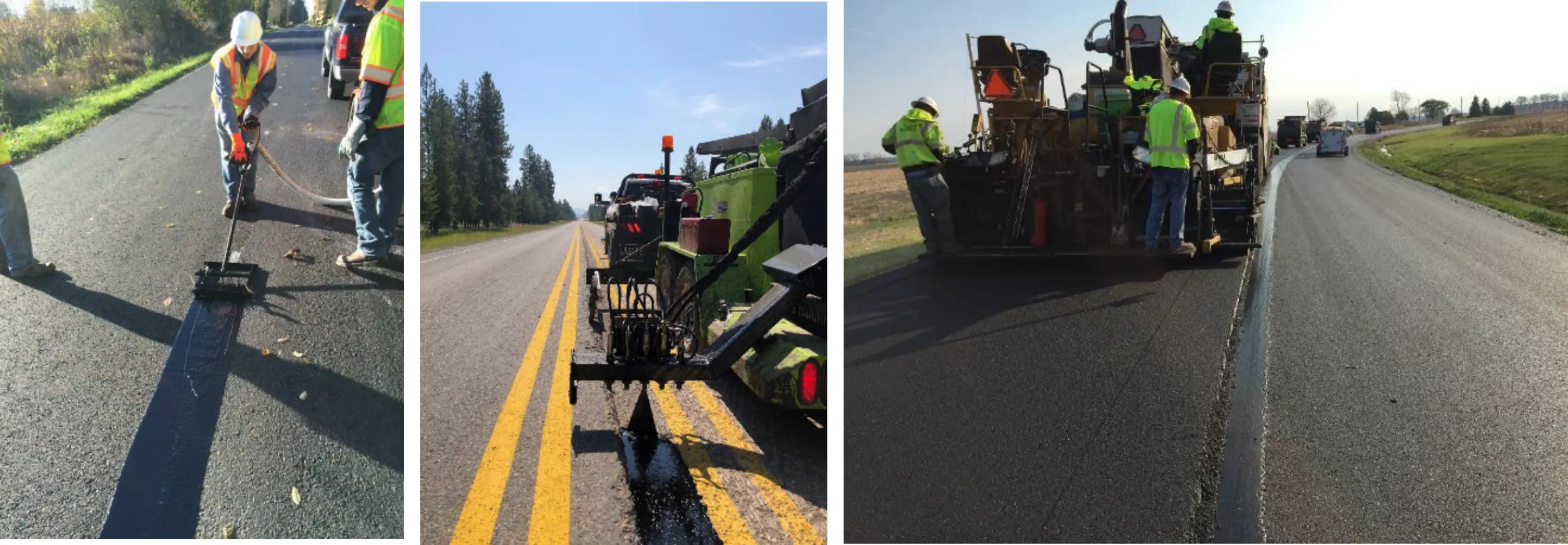
Rather than sealing the LJs from the top down, the product called VRAM is designed to seal the LJ from the bottom up. Use of VRAM involves applying a heavy band (1 gal/yd2 for a 1.5-inch overlay) about 18 inches wide of polymer-modified asphalt binder to the area where the new joint will be centered. The cold side is placed and compacted, passing over half the width of the band. Figure 149 shows two methods of placing the thick band and then paving over it. The hot side is placed and compacted as a conventional joint. The polymer-modified binder migrates into the mix at the joint, filling voids from the bottom up, reducing water intrusion at the joint and protecting underlying pavement layers. There currently is no proven way to get an exact measurement of in-place air voids of mixes where VRAM is used.
Source: Asphalt Materials, Inc.
Figure 149. VRAM Is Applied with Manual Strike-Off Box (left) or Modified Distributor (middle), then Paved Over (right)