
9. Joint Construction
9.1 Introduction
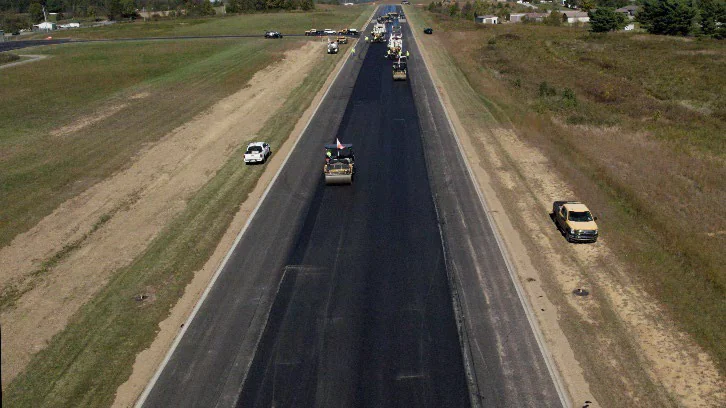
During the construction of asphalt pavements, two types of joints are encountered. The first is a transverse joint, which is constructed whenever the paving operation is interrupted for a period—anywhere from 15 min to several weeks or more. The second is a longitudinal joint (LJ), built when a lane is constructed adjacent to a previously placed lane of mix (see Figure 123). Both types of joints are key to performance; transverse joints have a significant impact on smoothness, while LJs greatly impact long-term durability.
Transverse joints have a significant impact on smoothness, while longitudinal joints (LJs) greatly impact long-term durability.
Source: National Asphalt Pavement Association
Figure 123. Longitudinal Joints on Airfield Runway
Joint deterioration starts when air, water, and contaminants find their way into the joint, through either segregation, poor density, or the two mats not bonding properly. Because the linear distance of LJs is so much greater than the linear distance of transverse joints, both on roadways and airfields, discussion around joint durability and joint deterioration is generally focused on the LJs.
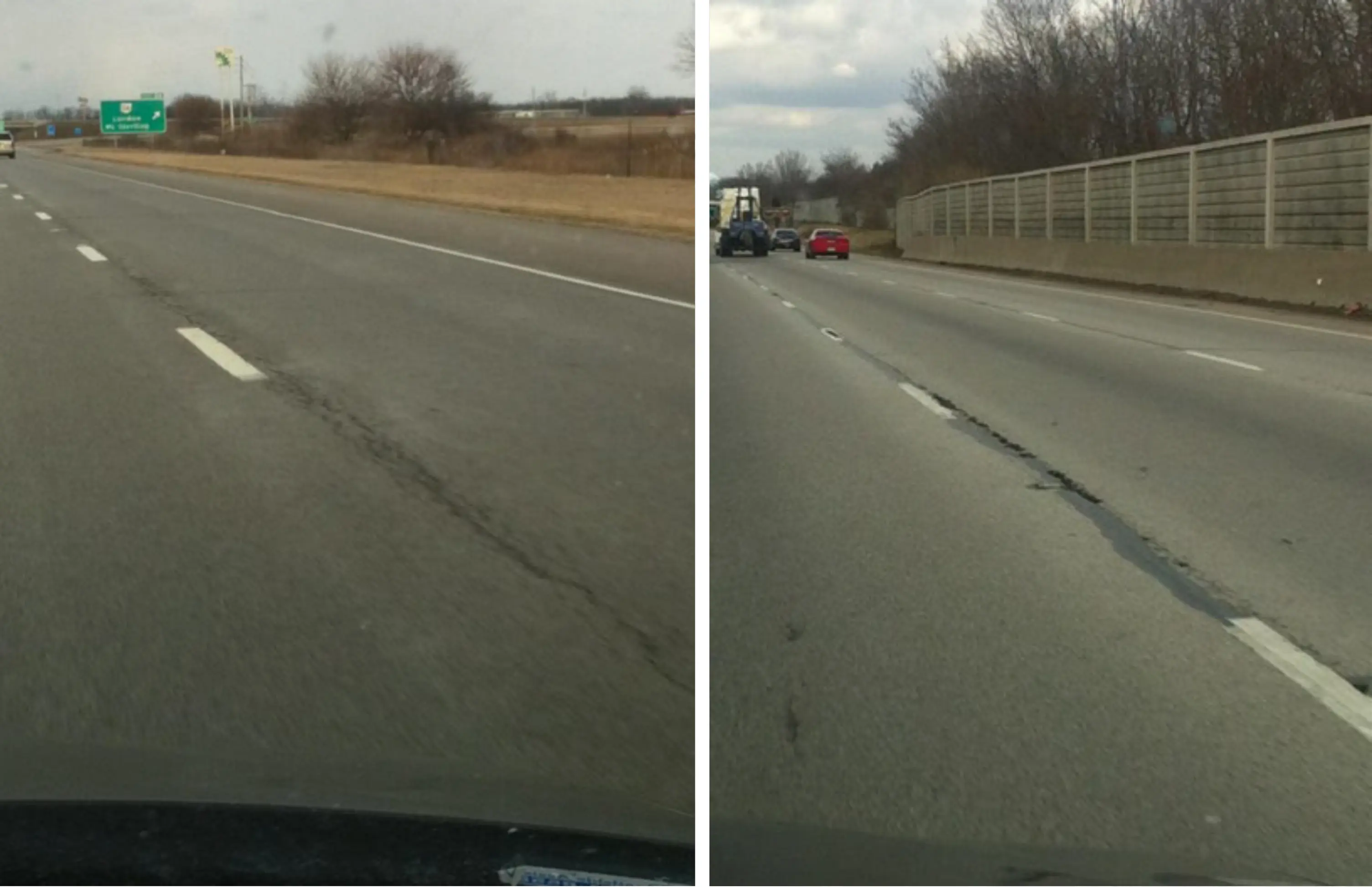
Typical distresses near the LJ are cracking and raveling (see Figure 124). As the joint deteriorates, it will require additional maintenance such as joint sealing, patching, or premature resurfacing. Since there are typically numerous LJs on a pavement, their performance is vital for the overall performance of a project. Unsatisfactory LJ performance has often been the weakest link in an otherwise long-lasting asphalt pavement.
Source: Asphalt Institute
Figure 124. Premature Deterioration of Longitudinal Joints
For airfields, cracking and raveling around the LJ leads to loose material on the pavement surface and is a major source of FOD that can be ingested and damage aircraft engines, as discussed in Section 1.2.
9.1.1 Chapter Outline
The techniques for constructing each type of joint are discussed in this chapter and were intentionally omitted from the two previous chapters on Mix Placement and Compaction to consolidate the discussion of joints here.
Transverse joints, also referred to as construction joints, are covered first, followed by a lengthy section on LJs. Echelon paving, a method that reduces the number of cold LJs, has its own section. The last section mentions some new LJ treatments and methods. Airfield considerations and techniques that are more prevalent for airfield paving, such as cutting back the LJ, are integrated within the appropriate sections of this chapter.
9.1.2 Terminology
When discussing both transverse joints and LJs, the following terms need to be defined (see also Figure 125):
Cold side, or unconfined side—the first side of the joint that was placed and allowed to cool before the other side of the joint was placed. This side has had the opportunity to cool after compaction and thus is referred to as the cold side of the joint. For LJs, it is also referred to as the cold lane. Because the mat was placed and compacted without any lateral confinement under the roller, it is also referred to as the unconfined side of the joint. The lack of confinement makes densification under the roller more challenging and is why specifications for airfield pavements call for cutting back and removing several inches of this lower density material.
Hot side, or confined side—the second side of the joint that was placed. This side is placed and compacted hot, next to the cold side, and thus is referred to as the hot side of the joint. For LJs, it is also referred to as the hot lane. Because the mat is placed next to a mat that has already cooled and stiffened, the mat under the roller is confined laterally. Because of the confinement, achieving density on this side of the joint is typically easier. One of the biggest problems on the hot side of the joint is failing to ensure that sufficient thickness of material (25 percent rolldown) is placed to allow for density to be obtained as the material is rolled down even with the cold side. This topic is covered in detail in Section 9.3.3.2.
Hot joint versus cold joint—The term hot joint refers to the circumstances where two lanes of mix are placed, and both lanes remain hot enough to allow for adequate compaction on both sides of the joint. A typical temperature limit in airfield specifications to distinguish between a hot joint and a cold joint is 175 °F, meaning if the mix temperature drops below 175 °F, it must be treated as a cold joint due to difficulty in achieving adequate density. Echelon paving is a technique that creates hot joints instead of cold joints.

Source: Asphalt Institute
Figure 125. Common Terms for Transverse and Longitudinal Joints